3-Position Lift Chair: Is It Enough, or Do You Need Infinite?
Aging Parent Rescue is a participant in the Amazon Services LLC Associates Program. We may earn a commission when you buy through links on our site, at no extra cost to you.
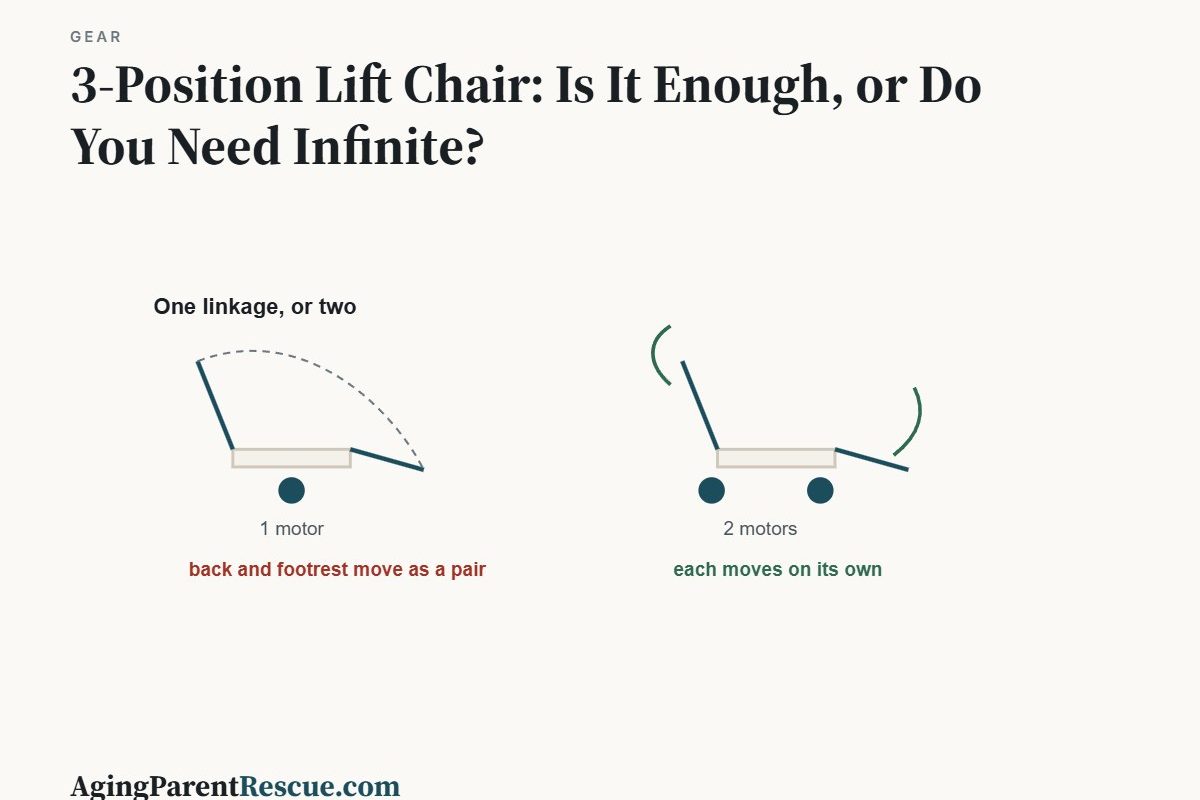
What the position count is actually describing. One motor moves the back and the footrest together, so the chair has a few fixed stops — sold as two-position or three-position. Two motors move them independently, which is all “infinite position” means. The number of positions is a consequence of the motor count, not a feature of its own.
Follows from how the chairs are built: one actuator can only drive one linkage.
So the question is not really whether three positions is enough. It is whether anyone in the house needs the legs to go up while the back stays upright. If the answer is no, a three-position chair does everything a more expensive one does, with fewer things to go wrong.
What the motors can and cannot do
A two-position chair goes upright and back to roughly a reading angle. A three-position chair adds a near-flat stop. Both run on one motor, and in both the footrest comes up as the back goes down. You cannot have your feet up and your back upright.
An infinite-position chair has a motor for each, so any combination is available, including the one that matters clinically: legs elevated with the trunk upright.
The test
Ask one question: has anyone told them to keep their legs raised?
If a doctor has mentioned swelling, oedema, circulation or keeping the feet above the heart, you want two motors, because a three-position chair can only raise the legs by laying the person back. For someone with breathing difficulty, or reflux, or who simply cannot tolerate lying flat, that trade is unacceptable and the chair stops getting used in the position it is needed in.
If nobody has said anything of the kind, and the chair is for getting up and sitting down comfortably, three positions is the right purchase. The extra motor is cost and complexity bought for a capability nobody uses.
The other case for two motors is sleeping. A three-position chair reaches a steep recline but rarely a properly flat one, and someone who spends nights in the chair will feel the difference.

If three positions is enough
MCombo Power Lift Recliner 7040
The deepest review history in the whole category, on a chair that does the ordinary job well. For something that lifts a person several times a day, that history tells you more than any extra function — the failures here are mechanical and they only show up over months.
- Powered lift and powered recline from one remote
- Back and footrest move together, which is the limit to check against your needs
- Battery backup brings the chair upright once if the power fails
Rating and review count checked on 15 September 2026. Price is not shown here because it changes; the button opens the current listing.

If the legs have to come up independently
MCombo 3-Motor Power Lift Recliner
Three actuators rather than two, so the back, the footrest and a third adjustment all move separately. Buy it for the independent footrest; treat the third motor as a bonus rather than the reason. Shallower review history than the simpler chairs, which is the pattern across this whole category.
- Back and footrest fully independent
- Reaches a genuinely flat position rather than a steep recline
- More actuators and more electronics than a three-position chair
Rating and review count checked on 15 September 2026. Price is not shown here because it changes; the button opens the current listing.
Zero gravity, and the other words
Zero gravity is a preset, not a mechanism. It names a posture — knees bent, thighs raised to about heart height, back reclined — that needs independent control of back and footrest. So a chair advertising zero gravity should have at least two motors. If a single-motor chair claims it, what you are getting is one of its fixed stops renamed.
Trendelenburg means the feet end up higher than the head. Some chairs offer it. Whether it is appropriate for a particular person is a medical question, not a shopping one — it is contraindicated in several common conditions, and the chair’s manual is not the place to settle it.
Lay-flat is worth checking literally. Plenty of chairs described that way stop several degrees short. If sleeping in the chair is the point, look for a stated angle or a photograph taken from the side.
Every motor is driven from one control board, and on most chairs that board also drives the lift. When it fails, the chair does not simply lose its massage function — it stops raising the person, sometimes while reclined. Check that a battery backup is fitted and that it will bring the chair upright at least once, keep the remote where it cannot fall down the side of the cushion, and make sure the mains lead is somewhere it will not be unplugged by the vacuum cleaner. This is home-setup advice; anything about how long someone should sit or sleep in a chair, or whether their legs should be elevated, belongs with their doctor or occupational therapist.
What the extra motor costs you
Price, first, but that is the smaller part. The real cost is complexity in a machine that runs several times a day for years. In this category the chairs with the deepest review histories and the best ratings are consistently the simpler ones, and the feature-heavy models sit a few tenths lower.
That is not an argument against buying two motors when you need them. It is an argument against buying them speculatively, in case they turn out to be useful. If the requirement is getting up and sitting down, buy the simplest chair that does it well and spend the difference on a bigger seat or a better fabric.
The decisions that come before this one — wall clearance, weight capacity, seat size, and getting the box into the house — are covered here: what actually decides a power lift recliner. Sizing to the person is here: small and tall lift chairs, and why seat depth decides, with weight rating against seat width for the larger end.
And if you are hoping some of this comes back: what Medicare pays toward a lift chair — the short version being the mechanism, not the chair, and only against a strict test.