Are Lift Chairs Covered by Medicare? What Part B Pays
Aging Parent Rescue is a participant in the Amazon Services LLC Associates Program. We may earn a commission when you buy through links on our site, at no extra cost to you.
The bar Medicare sets. The rule requires evidence that the person’s condition is severe enough that the alternative would be confinement to a chair or bed. Wanting help getting up is not the test. Most people asking this question do not meet it, and it is better to know that before the paperwork starts.
CMS National Coverage Determination 280.4, Seat Lift (Publication 100-3), effective 1 May 1989.
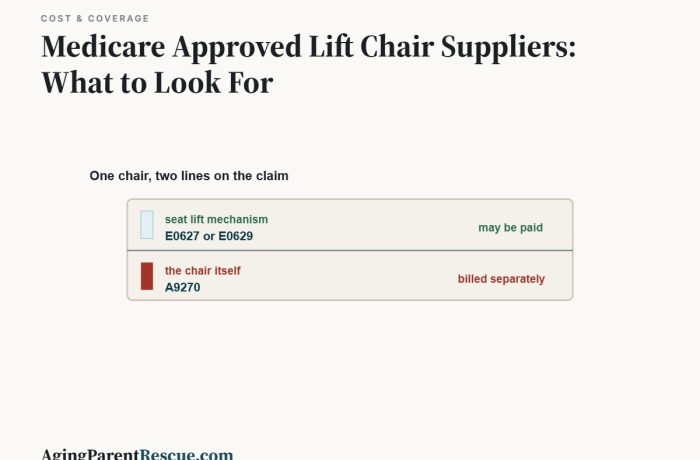
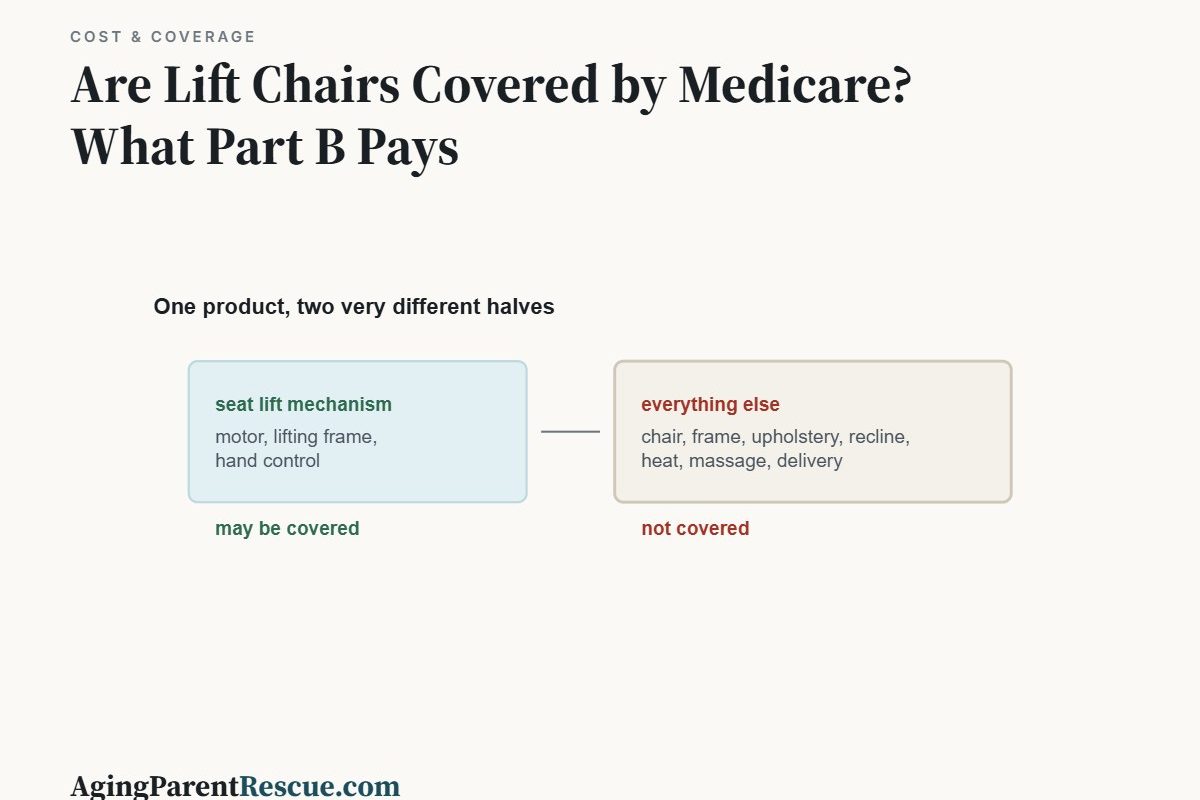
The short answer is that Medicare Part B can pay toward a lift chair, but not toward the chair. It pays toward the seat lift mechanism — the motor and frame that tilt the seat forward — and it treats that part as durable medical equipment. Everything that makes it a piece of furniture is yours to pay for.
That distinction is not a technicality invented by suppliers. It is written into the coverage rule, and it is the reason people who expect most of the cost back are disappointed.
What Medicare actually buys
The coverage rule says plainly that where a unit combines a recliner feature with the seat lift, payment is limited to the amount payable for a seat lift without that feature. So buying a better chair does not increase what Medicare pays. The covered item is the same small component regardless of what it is bolted into.
It also rules out one whole category of product. A lift that works by a spring release — the kind that launches someone out of the seat with a sudden motion — is specifically excluded. Covered lifts have to operate smoothly, be controllable by the person sitting in the chair, and get them up and down without anyone else helping.
The medical criteria, in plain words
A physician has to prescribe it, and the person has to have one of a short list of conditions: severe arthritis of the hip or knee, or muscular dystrophy or another neuromuscular disease. General frailty, being unsteady, being elderly, or having had a fall are not on that list.
Then the evidence has to show three things: that the lift is part of the doctor’s course of treatment, that it is likely to improve the condition or slow its decline, and that without it the realistic alternative is being confined to a chair or a bed.
There is also a quiet requirement that catches people out. The person has to be able to walk once they are standing. A seat lift is not covered for somebody who would transfer straight into a wheelchair, because then it is not helping them do anything a different piece of equipment would not.
Coverage decisions are made on the individual record by the supplier, the physician and the Medicare contractor for your state, and local policies add detail on top of the national rule. Use this page to understand what is being decided and what to ask, then get the answer for your situation from the prescribing doctor, the supplier, or 1-800-MEDICARE. Nothing here is medical advice, and nothing here is a promise about what will be paid.
What you pay if it is approved
Durable medical equipment sits under Part B. After the annual Part B deductible, you pay 20% of the Medicare-approved amount, and Medicare pays the rest — of the approved amount for the mechanism, not of the price of the chair.
Two conditions decide whether that 20% is the real number.
Both the doctor and the supplier must be enrolled in Medicare. If the supplier is not, the claim does not get paid at all, whatever the prescription says.
The supplier must accept assignment. A supplier who participates has agreed to the approved amount as full payment. One who does not can charge more, and the extra is yours. Ask this before the order, not after, because it is the difference between a predictable bill and an open one.
This is the same pattern that governs every piece of home equipment Medicare touches, and it is worth reading once for the general shape: how Medicare treats home safety equipment.
Why many families skip the claim
Add the parts up honestly. The covered item is one component of a chair. Medicare pays 80% of an approved amount for that component, after a deductible, and only if a doctor documents a condition from a short list plus the confinement test. Meanwhile you still pay for the chair, and you have to buy from a Medicare-enrolled supplier rather than wherever the chair you want is sold.
For a household that clearly qualifies, it is worth doing — free money is free money, and the supplier normally handles the paperwork. For a household that is borderline, the claim often costs more in weeks and phone calls than it returns, and the chair choice gets narrowed to what that one supplier stocks.
The honest routing is this. If the person has severe hip or knee arthritis or a neuromuscular diagnosis and their doctor already agrees a lift chair is part of treatment, start with the doctor and ask for a Medicare-enrolled supplier. Otherwise, buy the chair you actually want and treat the reimbursement as not happening.
If you are buying it yourself
Then the decision is a furniture decision with a mechanical core, and it turns on three measurements rather than on brand: the wall clearance behind the chair, the weight capacity, and the seat width and depth. Those are covered in full in what actually decides a power lift recliner.
Three follow-on pages cover the cases that do not fit the middle of the range: heavy-duty chairs and what the weight rating covers, what heat and massage really are, and why the dealer brands are hard to buy online.
One last point worth carrying into the shop. Because Medicare treats the lifting mechanism as the medical part, it is also the part worth judging hardest. A chair with beautiful upholstery and a motor that judders at the top of its travel is the wrong purchase whoever is paying.

If you are paying out of pocket
MCombo Power Lift Recliner 7287
A sensible retail choice when the claim is not worth chasing: a large frame with the deepest review history at this end of the range. Buying it this way means no supplier enrolment, no prescription and no approved-amount arithmetic — and no reimbursement either.
- Larger frame than the standard MCombo chair
- Powered lift and recline, with heat and vibration on the remote
- Bought retail, so it will not be reimbursed — check the wall clearance first
Rating and review count checked on 15 September 2026. Price is not shown here because it changes; the button opens the current listing.
Bought from a retailer rather than a Medicare-enrolled supplier, this chair cannot be claimed for. That is the trade you are making, and for most families it is the right one.
If the claim is worth making, the next task is finding somebody who can bill it: what to look for in a Medicare-enrolled supplier.