Toilet Safety Rails: Arms Without Changing the Height
Aging Parent Rescue is a participant in the Amazon Services LLC Associates Program. We may earn a commission when you buy through links on our site, at no extra cost to you.
What a toilet safety rail adds. It gives something to push down on and nothing else — the seat stays exactly where it was. If the toilet is already at a workable height and the only problem is the push up, this is the right product and a riser is the wrong one. If the seat is too low, a frame will not fix that.
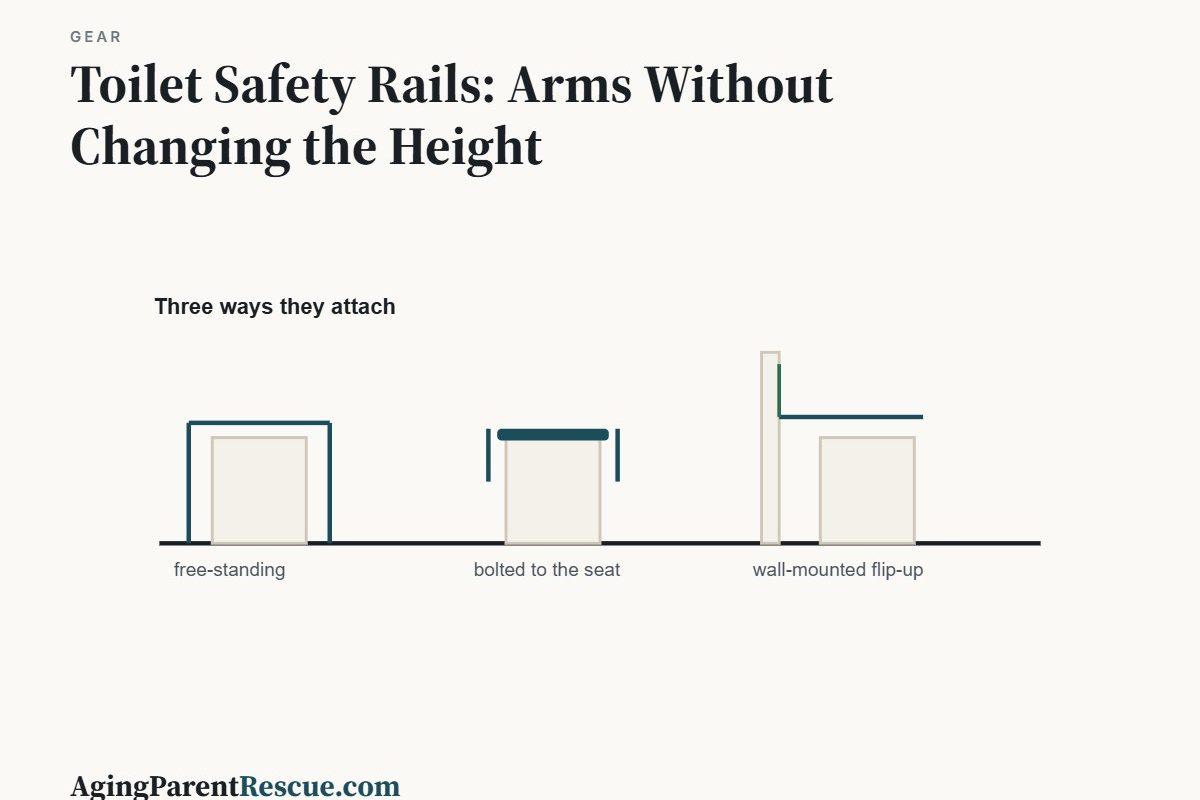
A frame stands on the floor or bolts to the seat hinge; neither changes the seat height.
People arrive at this product from two directions and only one of them ends well. Either they have measured, found the seat height is fine, and want arms — or they have decided the toilet is “too hard to get off” and are buying whatever comes up. The second route is how households end up with a frame that does not help and a riser that does not fit.
So measure first. Floor to the top of the seat. If it is under about 17″, you have a height problem as well: the toilet height that makes standing up possible and how much riser to add.
Three ways they attach
Free-standing frame. Four legs on the floor, straddling the toilet. Nothing to fit, nothing to drill, and it moves if it is pushed sideways. Best where the floor is flat and hard.
Bolted to the seat hinge. The frame’s uprights clamp under the existing seat bolts, so it is anchored to the pan rather than the floor. Steadier laterally, and it makes cleaning around the base far easier because there are no legs in the way.
Wall-mounted flip-up rails. Fixed to the wall, folded up when not needed. The steadiest by a wide margin and the only kind rated to be pulled on rather than pushed down on, because the load goes into the structure. Also the only one that needs a stud or a backing board.

Best for most bathrooms
Medline Toilet Safety Rail
Anchors to the seat bolts rather than standing on the floor, which is what stops it walking sideways when someone pushes off one arm. Twenty-five thousand ratings is unusual depth for this category and it is the reason to start here.
- Bolts under the existing seat, so it cannot slide on the floor
- Arm height and width adjust to the person
- Nothing standing on the floor, so cleaning round the pan still works
Rating and review count checked on 15 September 2026. Price is not shown here because it changes; the button opens the current listing.

If you cannot touch the toilet
Carex Toilet Safety Frame
The free-standing option, for a rented flat, a toilet whose seat bolts are seized, or a household that wants to be able to remove it without trace. It stands on the floor, so check the floor is flat and that all four feet load evenly.
- No fixing to the toilet or the wall at all
- Height and width adjust
- Four legs on the floor — keep it off any bath mat
Rating and review count checked on 15 September 2026. Price is not shown here because it changes; the button opens the current listing.
Setting the arm height and width
Both adjust, and both are usually left at whatever they came at. Sit the person down and set the arms so their forearms rest level with a slight bend at the elbow — high enough that they can press down without shrugging, low enough that the push starts with the elbow bent rather than straight.
Width matters as much. Arms too wide and they cannot reach both without leaning; too narrow and they are wedged and cannot get their hands underneath to push. The test is whether both hands land naturally with the palms down, without the person having to look.
A toilet frame carries a rating for downward load through both arms on a frame that is correctly fitted. It is not a grab bar: pull one sideways hard enough and a free-standing frame will move, and a seat-bolted one loads the pan rather than the wall. If the person needs something that will hold when they lose their balance rather than something to press on as they rise, that load belongs on the wall, into structure: what a grab bar has to withstand and where it has to be fixed. Re-check the fixings monthly — the clamps loosen with cleaning — and if the frame has ever shifted under load, take it off and refit it rather than telling somebody to be careful.
The cleaning problem, again
A free-standing frame puts four legs and two uprights around the base of the toilet, in the exact place that needs cleaning most. Whoever cleans that bathroom now has to work around six new obstacles, or move the frame each time and reposition it.
That is the quiet reason frames get pushed to one side and stop being used. Seat-bolted rails avoid it almost entirely, which is a large part of why they are the better default. If a free-standing frame is the only option, choose one that lifts off cleanly in one movement.
Frame, riser, or both
The honest decision tree is short.
Seat height fine, standing up hard. A frame. Nothing else needed.
Seat too low, standing up hard. A riser with integrated arms does both jobs in one part and leaves the floor clear: how much height to add, and the riser shapes.
Seat too low, and they need something solid to hold. A riser for the height and a wall bar for the hold. Not a frame — you would be stacking a frame on a riser, and the taller the assembly the less stable it is.
For the room as a whole, in the order the work is usually best done: the bathroom, one change at a time.