Bath and Shower Chairs for Elderly Parents: The Missing Half
Aging Parent Rescue is a participant in the Amazon Services LLC Associates Program. We may earn a commission when you buy through links on our site, at no extra cost to you.
A shower chair solves sitting down. It does not solve standing back up, because the arms of a plastic chair are rated for pushing down on, not for pulling against, and the chair itself is not fixed to anything. The other half of the fix is a wall bar within reach of the seated position.
Chair arms carry a weight rating for even, downward loading; a wall grab bar is rated to 250 lbf applied in any direction into the structure behind it.
This is the gap in almost every shower chair purchase. The chair goes in, the person can wash sitting down, and then they discover that getting up off it on a wet surface with nothing solid to hold is harder than what they were doing before.
Buy both, at the same time, and set them to each other.
Which chair, by what the person can still do
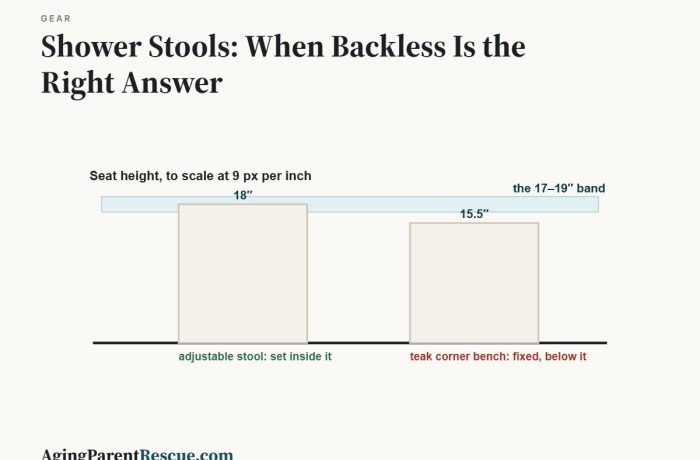
They can sit unsupported and stand easily; they just tire. A bench or a backless stool is enough, and it takes the least space: shower stools, and when backless is the right answer.
They lean or reach while washing. Get a back. Washing your own feet or hair shifts the centre of gravity forward and sideways, and a backless seat gives nothing to work against.
Standing up is any part of the difficulty. Get arms as well — and a wall bar. The arms give a downward push; the bar gives something to pull on when the push is not enough.
They cannot step over the tub rim safely. None of these help. That needs a bench that straddles the wall: which transfer bench to buy.

Best for most people
Medline Shower Chair with Padded Armrests
The deepest review history of any shower chair, with the arms and back that most households turn out to need. Padding matters more here than it sounds: bare plastic arms are cold, slippery when wet, and unpleasant to push down on with bony forearms.
- Padded arms to push down on, and a back to lean against
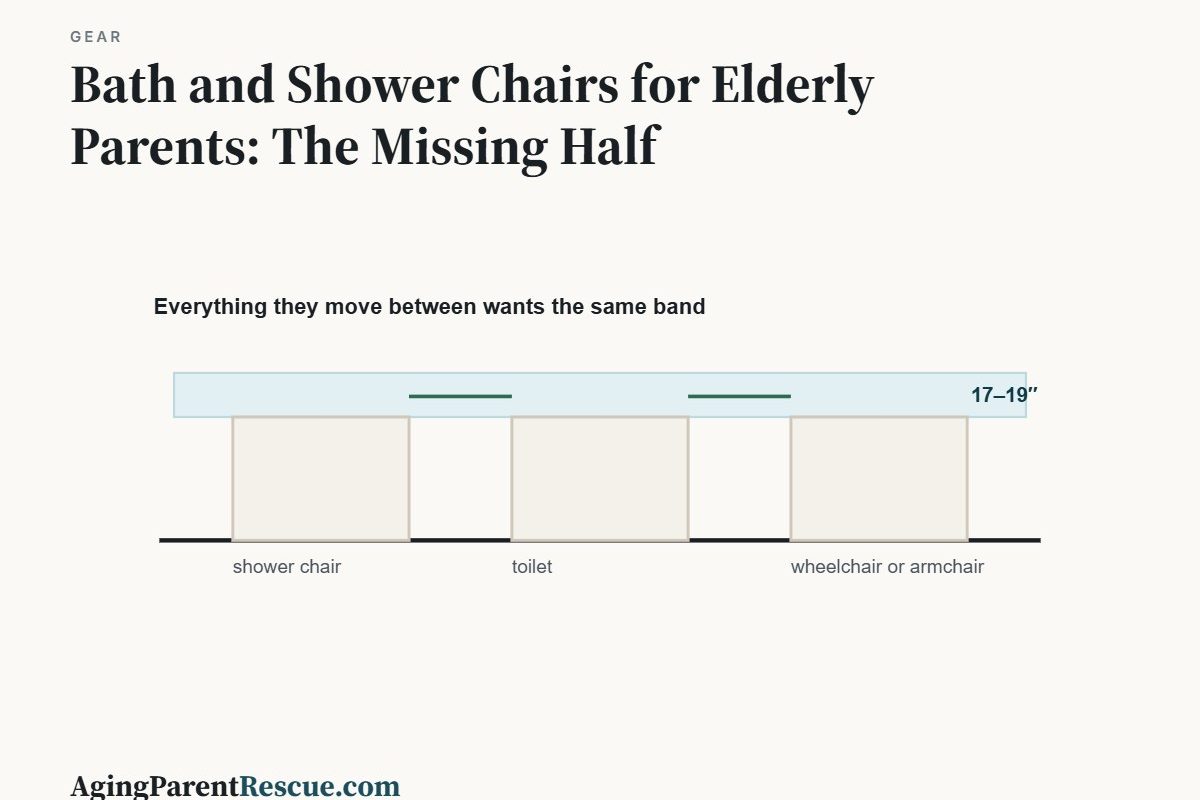
- Legs adjust — set them to the 17–19″ transfer band
- Drainage holes, so the seat is not a puddle
Rating and review count checked on 15 September 2026. Price is not shown here because it changes; the button opens the current listing.
Arms add width. Measure the enclosure at floor level before ordering, because this is the version that most often will not go in.
Set the height before the first wash
Measure from the shower floor to the top of the seat, not from the tub rim. Then check it against the toilet in the same room, because those two are the transfer pair that gets used most: the shower seat height that works and the toilet height it should match.
Feet flat on the floor of the enclosure, knees at about a right angle. If the heels lift, drop a notch on all four legs — all four, not two.
Where the bar goes
Two positions do almost all the work. A horizontal bar along the long wall, within reach of the seated position, for pulling up on and steadying while washing. And a vertical bar at the point of entry, held while stepping in, which is the single highest-risk movement in the room.
Both have to go into structure, not into the panel. A bar that pulls out of a fibreglass surround is worse than no bar, because the person has already committed their weight to it: what a grab bar has to withstand and where it has to be fixed, and if there is no stud where you need one, fitting to a fibreglass shower with no studs.

If the arms get in the way
Padded Shower Chair with Back
A back without full arms, for enclosures where an armchair-shaped seat will not fit or where the arms make the sideways transfer harder. Well rated, with a much shallower review history than the Medline — which is the usual trade at this end.
- Back to lean against, narrower overall than a chair with arms
- Padded seat rather than bare plastic
- Pair it with a wall bar, because there is nothing to push down on
Rating and review count checked on 15 September 2026. Price is not shown here because it changes; the button opens the current listing.
A mat compresses unevenly under four small feet, so a chair that was level becomes a chair that rocks, and it rocks at the moment weight goes onto one arm. If the floor is slippery for bare feet, fix that separately — texture strips, or a mat that is removed before the chair goes in. The same applies to suction feet: they hold on smooth clean acrylic and hold very little on textured tub floors or tile with grout lines: stopping a shower chair sliding on a tub floor. Load-test the chair yourself before anyone uses it, and if the person cannot lower themselves onto it under control, that belongs with their occupational therapist rather than with another purchase.
The things that decide whether it stays in use
Drainage. A solid seat holds water and gets cold and slimy. Holes, or a moulded seat that sheds, is not a luxury.
Weight. If the chair has to come out of the tub after every wash so the rest of the household can use it, it needs to be light enough for whoever does that. The chairs that get left in place are the ones that fit the bathroom permanently.
Width. Measure at floor level, and measure the door opening too. A chair that fits the footprint and cannot be turned in through the door is the most common return in this category.
For genuinely tight enclosures the standard shapes often will not work at all, and there are narrower answers: shower chairs for small bathrooms. For the whole room in order: the bathroom, one change at a time.