Bathtub Grab Bars: Clamp-On Rail or Wall Bar
Aging Parent Rescue is a participant in the Amazon Services LLC Associates Program. We may earn a commission when you buy through links on our site, at no extra cost to you.
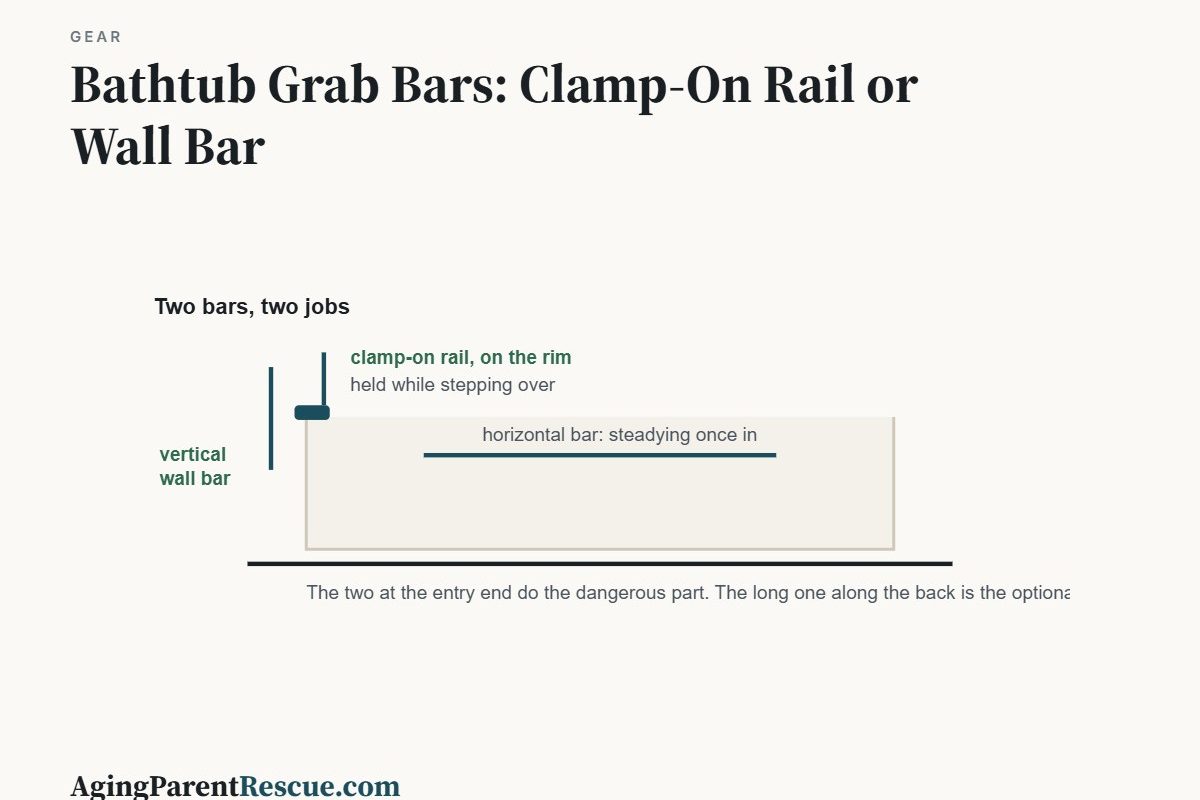
The movement a bathtub bar exists for. Getting into a tub is done on one leg, over a raised wall, on a wet surface, usually while the other hand holds nothing. It is the highest-risk few seconds in an ordinary house, and it is the reason a vertical bar at the point of entry matters more than a horizontal one along the back.
A vertical bar is held while the body rises and rotates; a horizontal one is for steadying once already in.
Bathtubs get two kinds of bar, and they solve different halves of the problem. Most households fit one of them, usually the wrong one, because the clamp-on rail is easy to buy and the wall bar needs a drill.
Clamp-on rail or wall bar
A clamp-on tub rail grips the rim of the tub with a screw clamp. It goes on in ten minutes, needs no fixings, and gives a handle exactly where the step over happens. It comes off when the person moves out, which matters in a rental.
A wall bar goes into structure and is rated to take a real fall load. It cannot be positioned on the rim, so it works for steadying inside the tub and for the final part of standing up.
The honest summary: the clamp-on rail is better positioned and weaker; the wall bar is stronger and worse positioned. Which is why the answer for most tubs is one of each, and why fitting only the clamp-on rail is the common half-measure.

Best for the step over
Vaunn Medical Bathtub Safety Rail
The clamp-on rail with by far the deepest review history, which in a product whose whole job is not slipping on a rim is the number that counts. Check your tub wall thickness against the clamp range before ordering — thick-walled and tiled-in tubs are where these do not fit.
- Clamps to the tub rim, so the handle is at the step-over point
- No drilling, and it comes off without a trace
- Check the clamp range against your rim thickness first
Rating and review count checked on 15 September 2026. Price is not shown here because it changes; the button opens the current listing.

The bar on the wall
Moen Home Care Grab Bar, 18 Inch
A short bar mounted vertically at the entry end is the single most useful fixing in a bathroom with a tub. Short is correct here: the job is one hand, one hold, at one moment, and a long bar simply costs more wall.
- Single-grip length, for a vertical mount at the step-over
- Into studs or a backing board — not into the panel alone
- Same 1¼–2″ diameter rule as every other grab bar
Rating and review count checked on 15 September 2026. Price is not shown here because it changes; the button opens the current listing.
Where each one goes
The vertical bar goes on the wall at the end you step in from, with the bottom of it low enough to grab while still standing outside the tub. The rim rail goes on the same end, so the two hands are working at the same point rather than pulling the body in two directions.
A horizontal bar along the long wall is useful once someone is in and sitting, and useless during the step over, because a horizontal bar cannot be gripped progressively as the body rises.
Heights, gaps and the rest of the geometry are the same as for any other bar: grab bar height, the gap behind the bar, and what “ADA compliant” does and does not certify.
It clamps to a tub wall that was designed to hold water, not to take a sideways load from a falling adult. Used as intended — a steadying handle, gripped before the weight shifts — it is genuinely useful. Used as the thing that stops a fall, it can rotate on the rim or take the tub panel with it. Check the clamp before every few uses by pulling it firmly sideways, and re-tighten on a schedule rather than when it feels loose. Never fit one to an acrylic tub whose rim flexes when you press it. And no suction-cup product belongs in this role at all: what to do when there is no stud where you need one. If the step over is already unsafe rather than just hard, the answer is to remove the step rather than to add a handle.
When bars are not the answer
There is a point past which no handle helps, and it arrives when the person can no longer lift a foot clear of the rim reliably. At that stage the fix is to delete the movement rather than support it: a transfer bench straddles the wall so they sit down outside and slide across, and the step over never happens.
That is a bigger change and a better one: which transfer bench to buy, and if the tub is small or awkwardly shaped, whether a bench will fit a 30-inch tub.
If they are managing the step but cannot stand through a wash, that is a different product again: shower chairs, and why a chair alone is half the fix.
Before you order
Measure the tub rim thickness with a ruler laid across it, at the end they step in from — not in the middle, because many tubs taper. Clamp ranges are narrow and a rail that will not close on your rim is the most common return here.
Then check what is behind the wall where the vertical bar would go. If it is a fibreglass surround with no stud in reach, solve that before buying the bar, not after: fitting a grab bar to a fibreglass shower, and in a manufactured home, the different framing you will meet.