ADA Compliant Bathroom Grab Bars: What the Label Means
Aging Parent Rescue is a participant in the Amazon Services LLC Associates Program. We may earn a commission when you buy through links on our site, at no extra cost to you.
What “ADA compliant” means on a product listing. It says the bar meets the dimensional and strength requirements for grab bars. It says nothing about whether your installation is compliant, because compliance is a property of the whole assembly — and because the ADA does not apply to a private home in the first place.
ADA Standards for Accessible Design, §609 (grab bars) and §604.5 (grab bars at water closets).
That is not a reason to ignore the standard. It is the best dimensional guidance that exists for this, it was arrived at by testing how people actually push themselves up, and every number in it is worth copying at home. It is a reason to stop treating the phrase on a box as a safety guarantee.
Here is what the standard actually specifies, what it does not, and which of those numbers matter in a house.
The numbers that make a bar compliant
Diameter. A round bar has to be 1¼″ to 2″ outside diameter. A non-round bar has to be no more than 2″ across and have a perimeter between 4″ and 4.8″. That range exists so an average hand closes around it: why the diameter decides whether a hand can hold on.
Gap to the wall. Exactly 1½″ between the wall and the bar. Not a minimum and not a maximum — a single figure, because a narrower gap traps a hand and a wider one lets a forearm through: the gap behind the bar, and why it is a target.
Height. Horizontal, 33–36″ above the finished floor, measured to the top of the gripping surface: how to measure grab bar height properly. And horizontal is not a stylistic choice — the angle a grab bar should be mounted at.
Strength. The assembly has to withstand 250 lbf applied at any point — and the standard names the bar, the fastener, the mounting device and the supporting structure. That last phrase is the whole reason a compliant bar can be an unsafe installation: what the 250-pound figure is really testing.
The two bars at a toilet
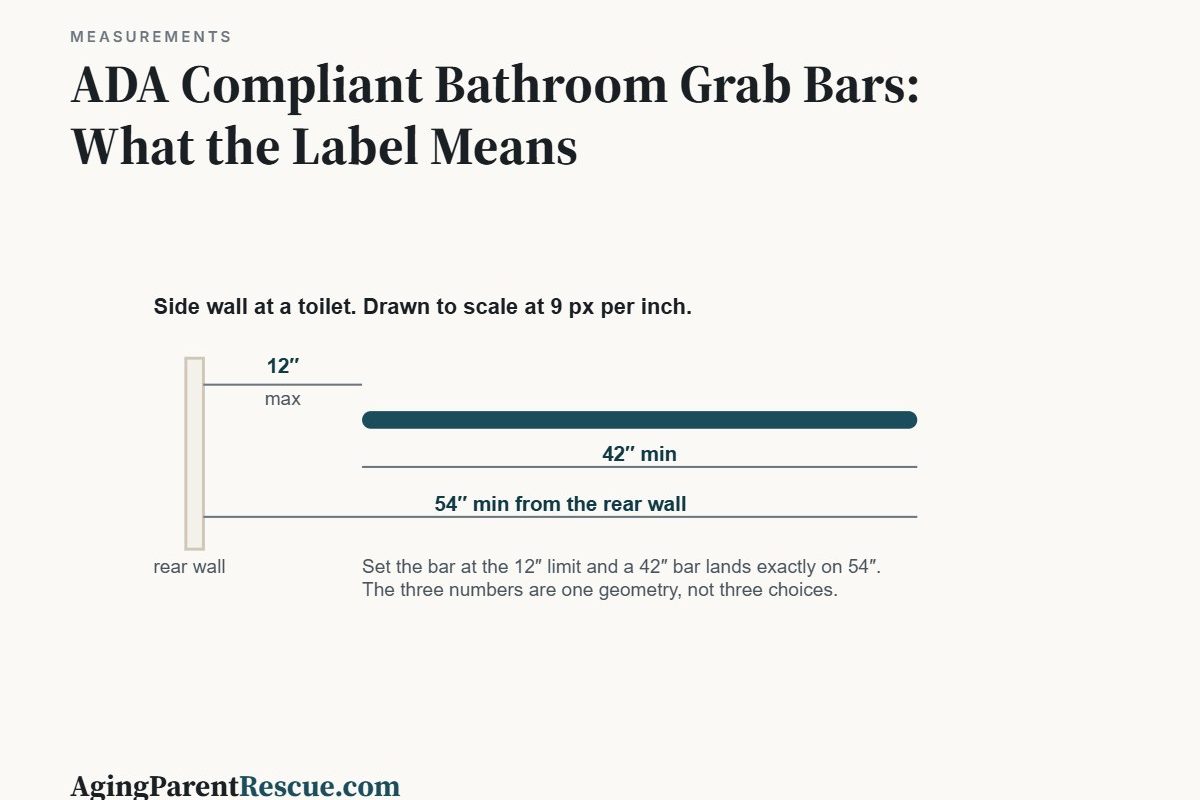
The side wall bar is the one that does the work. It has to be at least 42″ long, start no more than 12″ from the rear wall, and reach at least 54″ from it. Those three figures are consistent with each other: a 42″ bar mounted at the 12″ limit finishes at exactly 54″. Buy shorter than 42″ and you cannot satisfy the geometry however you position it.
The rear wall bar is at least 36″ long, extending at least 12″ from the toilet centreline on one side and 24″ on the other. Where the wall genuinely will not take 36″, the standard allows a 24″ bar centred on the toilet instead — which is the case in most domestic bathrooms, where the cistern and the corner eat the space.
At home, if you fit only one bar, fit the side wall one. It is the one a person pulls against to stand, and the rear bar mostly steadies.

The side wall bar
Amazon Basics Grab Bar, 42 Inch
The length the standard actually asks for at a toilet, and the one most households skip because a shorter bar looks tidier. If there is room for 42″, fit 42″ — the extra length is what lets someone reach it before they are committed to standing.
- Length that satisfies the 42″ minimum for a side wall bar
- Knurled or textured gripping surface rather than polished
- Concealed flanges, which still need real fixings behind them
Rating and review count checked on 15 September 2026. Price is not shown here because it changes; the button opens the current listing.

For the entry point
Moen Home Care Grab Bar, 18 Inch
A short bar is the wrong choice at a toilet and the right one at a shower entry, mounted vertically, where the job is a single hold at the moment of stepping in. Buying one short bar and calling the bathroom done is the common mistake this page exists to prevent.
- Single-grip length: one hand, one position
- Suits a vertical mount at the point of entry
- Same 1¼–2″ diameter rule applies
Rating and review count checked on 15 September 2026. Price is not shown here because it changes; the button opens the current listing.
The strength requirement names the supporting structure, not just the bar. A certified stainless bar screwed into plasterboard with the plugs that came in the bag will pull out, and it will pull out at the moment somebody puts their whole weight on it, which is the worst possible moment. Find the studs, or fit a backing board, or use fixings rated for the substrate you actually have. If a bar has ever moved under load, take it off and start again rather than tightening it: why a grab bar works loose, and what to do. Nothing here is a substitute for a professional assessment where the person’s balance or weight-bearing has changed.
It does not apply to your parent’s house
Worth saying plainly, because listings imply otherwise and because people worry about it. The ADA covers public accommodations and commercial facilities. A private home is neither. Nobody will inspect the bathroom and no bar has to be certified: what the ADA does and does not require at home.
Use the numbers anyway. They are the tested-safe dimensions, they cost nothing to follow, and they are a far better reason to put a bar at 34″ than “that looked about right”. Where domestic reality and the standard conflict — a 36″ rear bar that will not fit, a stud in the wrong place — the standard loses, and the right answer is the best bar the wall can actually hold.
The walls most houses actually have
Two situations account for most of the trouble, and both have their own answer.
A fibreglass or acrylic shower surround with no stud where you need one. The panel flexes, so anchors that work in plasterboard are not enough: fitting a grab bar to a fibreglass shower with no studs.
A manufactured or mobile home. Thinner walls, different framing, different spacing: fitting a grab bar in a mobile home.
Neither is a reason to fall back on a suction bar. Suction cups are for steadying, not for catching a fall, and no suction product meets the 250-pound requirement.
Bathtub and shower positions
The standard sets separate layouts for bathtubs and for showers, with bars along the back wall and at the control end. At home the useful simplification is this: one horizontal bar along the long wall at 33–36″ for the whole time someone is in there, and one vertical bar at the point where they step over the rim, where the hold happens on one leg.
That vertical bar is the one that gets left out, and stepping over the rim is the movement with the highest risk in the room. If the step over is already difficult, the bar may be the wrong fix altogether — a bench removes the step instead: which transfer bench to buy.
For the room as a whole, in the order the work is usually best done: the bathroom, one change at a time.
The tub is the position most often got wrong, because the bar that matters there is vertical and at the entry end: bathtub grab bars, clamp-on rail or wall bar.