Outside: Paths, Steps, and Getting to the Car
Aging Parent Rescue is a participant in the Amazon Services LLC Associates Program. We may earn a commission when you buy through links on our site, at no extra cost to you.
Outdoor falls tend to be worse than indoor ones — harder surfaces, further from help, and often nobody notices for a while.
The path
- Even surface with no lifted slabs. A one-inch lip is enough to catch a foot or a walker wheel.
- Wide enough for a walker — about 36″ where possible.
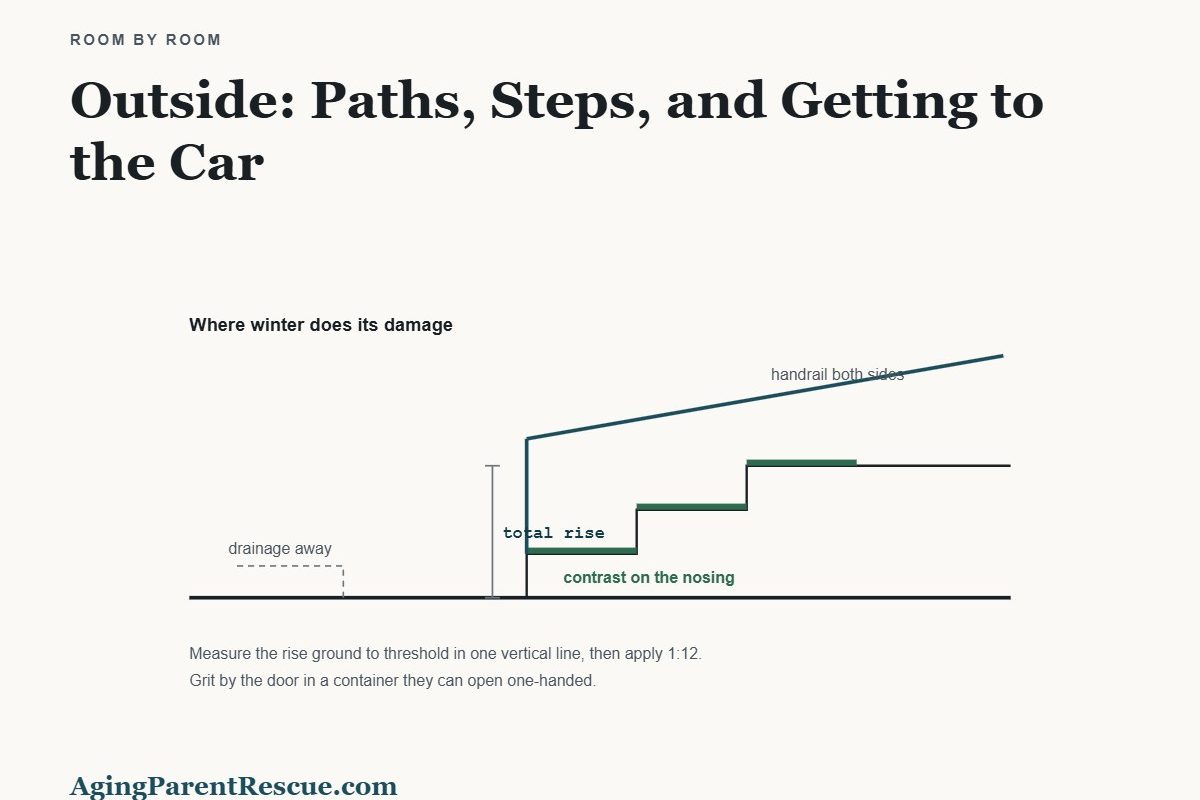
- Drainage that does not run across the walking line, because that is where ice forms.
Steps
Handrails on both sides. Contrast on the step edges so the nosing is visible in low light. If a ramp is being considered, measure the total rise — ground to threshold in one vertical line — and apply 1:12.
Light
Motion-sensing light covering the path, the steps and the keyhole. From late autumn, most arrivals home happen in the dark.
The transfer between wheelchair or walker and car seat happens on a driveway that is often sloped and wet. A swivel cushion helps with the turn; a grab handle that hooks into the door striker gives something to pull on. Neither is a substitute for a level, dry place to do it.
Winter
Grit kept by the door in a container they can open one-handed. Small hard walker casters do not cope with snow or grit, so plan for the days when going out is not reasonable.