Drive Medical Rollator Walkers Compared: Budget Frame to Nitro
Aging Parent Rescue is a participant in the Amazon Services LLC Associates Program. We may earn a commission when you buy through links on our site, at no extra cost to you.

Where the grips should sit when the person stands beside the rollator with their arms hanging relaxed. Every model in this range adjusts to reach it, which is why handle height is not a reason to pick one over another. The real differences are weight, wheels and how it folds.
Standard walker-fitting rule: grips level with the wrist crease, which leaves the elbows slightly bent when the hands are on them.
Drive Medical’s rollators split into two families that happen to share a brand. The budget frames are the ones most people mean when they say “a rollator”. The Nitro line is a different design at several times the money, and the question worth answering is what that money actually buys.
What separates the two families
Swivelling front wheels. On the budget frame the front wheels are fixed and the whole rollator has to be steered by pushing it round. A Nitro’s front wheels castor independently, so it changes direction from the wrist. In a house with corners that is a genuine difference, not a showroom one.
The fold. A budget rollator folds flat and then has to lean against something. A Nitro folds along its length and stands upright on its own footprint, which is why it suits a car boot and a narrow hall.
Weight. The aluminium and carbon-fibre frames are lighter to lift than the steel budget model, and lifting is where the burden usually falls on whoever is helping rather than on the person using it.
What the money does not buy is stability or a better seat. The budget frame is not unsafe, and if the rollator lives on one floor and never goes in a car, the expensive line solves a problem you do not have.

Best of the Nitro line
Drive Medical Nitro Euro-Style Rollator (RTL10266)
The highest-rated rollator in the range by a clear margin, and the model the rest of the Nitro line is derived from. Worth it when the rollator goes outdoors, into cars and round corners — which is to say, when the person is still going places.
- Front wheels swivel, so it steers from the wrist
- Folds upright and stands on its own
- Larger wheels than the budget frame, better on pavement and thresholds
Rating and review count checked on 11 September 2026. Price is not shown here because it changes; the button opens the current listing.
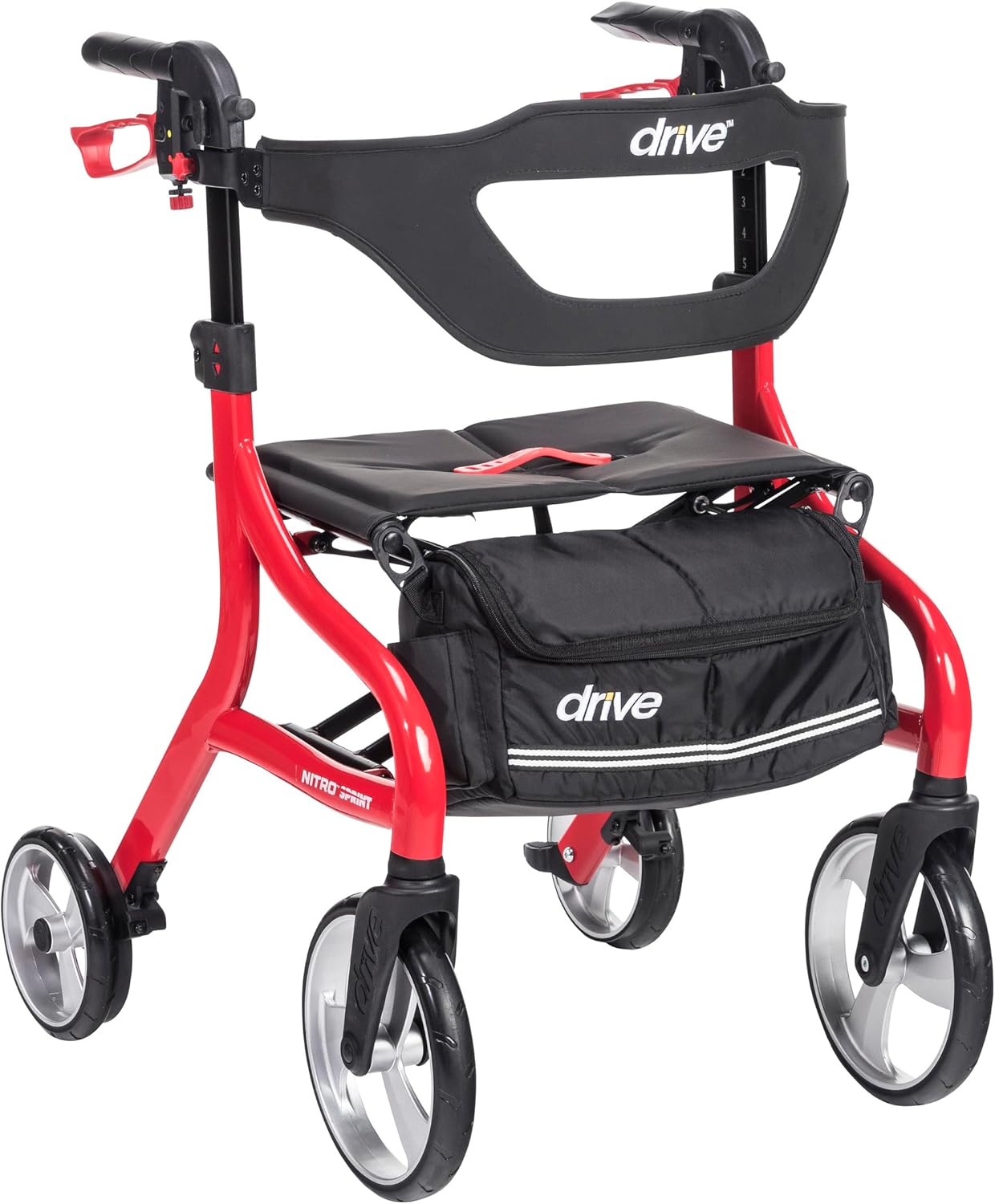
The middle of the range
Drive Medical Nitro Sprint Rollator
The Nitro design at a smaller step up from the budget frame. Rated lower than the Euro-style model by its owners, so treat it as the compromise it is rather than the obvious pick.
- Swivel front wheels and the upright fold
- Closer to the budget frame on price than the rest of the line
- Sold under several listing codes for the same frame in different colours
Rating and review count checked on 11 September 2026. Price is not shown here because it changes; the button opens the current listing.

Lightest to lift
Drive Medical Nitro Elite CF (Carbon Fibre)
Buy this one for the weight, and only for the weight. If the person lives alone and has to get the rollator into a car themselves, the carbon frame is the thing that makes that possible. Otherwise it is the Euro-style model with a bigger bill.
- Carbon-fibre frame rather than aluminium
- Same swivel wheels and upright fold as the rest of the Nitro line
- The model to consider when nobody else is there to lift it
Rating and review count checked on 11 September 2026. Price is not shown here because it changes; the button opens the current listing.
Outside the middle of the range
Junior and petite frames. Standard rollators are built for someone around average adult height. If the grips are at their lowest setting and still above the wrist crease, you need a junior frame rather than a lower adjustment — the seat and the wheelbase scale with it, not just the handles.
Bariatric frames. These raise the weight rating and widen the seat together. A wider seat also means a wider overall frame, which puts the doorway measurement back in play, so check it before ordering: what to do when the rollator will not fit through the door.
For the straightforward four-wheel decision inside the budget line, the wheel size is the whole question: the Drive Medical four-wheel rollator, 7.5″ against 6″.
Parts, and identifying what you actually own
Rollator parts are cheap and the common failures are predictable: brake cables stretch, brake pads glaze, wheels develop flat spots, and the seat strap frays where it meets the frame. All of those are replaceable, and replacing them is far better value than a new rollator.
The problem is ordering the right one, because the range shares nothing between families. Before you buy a part, find the label on the frame — usually inside a leg or under the seat — and use the model code printed there rather than the description you remember. A brake cable for a Nitro will not fit a budget frame, and neither will the wheels.
If the label is gone, measure the wheel diameter and count whether the front wheels swivel. That pair of facts puts you in the right family, and the family is where the parts compatibility lives.
The setup that gets skipped
Whichever model arrives, do two things before the first walk. Set the grips to the wrist crease. Then squeeze both brakes and check the wheels actually lock rather than drag — new rollators are frequently shipped with the cables slack, and a rollator whose brakes do not hold is a seat that rolls away when someone sits on it.
Both adjustments take a spanner and five minutes, and they are the difference between a device that helps and one that quietly becomes a hazard.
What “Euro-style” actually refers to
The name describes the shape, not a feature set. A Euro-style rollator has a narrow upright frame with the fold running along its length, styled on European walkers rather than the wide American pattern — which is why it stands up on its own when folded and why it suits a narrow hall. Listings use Euro style and Nitro DLX for the same design.
It is worth separating from the word “narrow”, which is about overall width and is the measurement that decides whether it fits your doorways. A Euro-style frame is usually narrower than the budget one, but check the figure rather than trusting the name.