Does Medicare Cover Grab Bars?
Aging Parent Rescue is a participant in the Amazon Services LLC Associates Program. We may earn a commission when you buy through links on our site, at no extra cost to you.
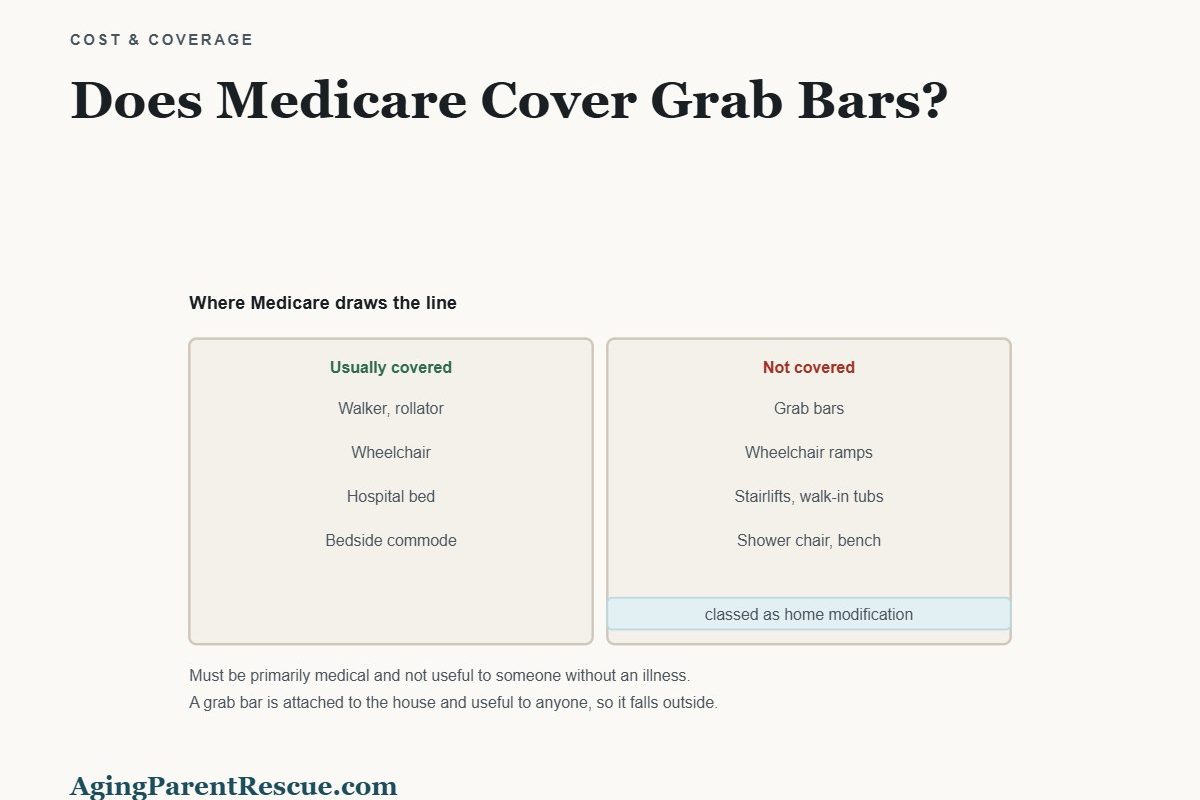
Original Medicare does not cover grab bars, ramps, walk-in tubs or stairlifts. They are treated as home modifications, not durable medical equipment.
Coverage rules change. Check the current position with Medicare directly before making a decision.
The line Medicare draws
Durable medical equipment must be primarily medical in nature and not useful to someone without an illness or injury. A grab bar is attached to the house and is useful to anyone, so it falls outside. The logic is consistent even when the outcome is frustrating.
What generally is covered
| Item | Usually covered? |
|---|---|
| Walker, rollator | ✅ With a prescription |
| Wheelchair | ✅ With documented need |
| Hospital bed | ✅ With documented need |
| Bedside commode | ✅ Often |
| Grab bars, ramps, stairlifts, walk-in tubs | ❌ No |
| Shower chair, transfer bench | ❌ Usually not |
Other routes worth checking
- Medicare Advantage. Some plans add a supplemental benefit for safety equipment. Plan-specific — ask yours.
- Medicaid waivers. Home and community-based services waivers vary by state and do sometimes cover modifications.
- Veterans’ programmes. There are grant programmes specifically for home adaptation.
- Area Agency on Aging. Local programmes sometimes install bars free or at low cost.
So plan on paying for it
The practical consequence: a bar and its anchors are an out-of-pocket purchase for most families. It is also one of the least expensive things on the list, which is worth remembering when the answer to this question is disappointing.
The same rules decide what Medicare pays toward a lift chair, with one extra test that catches most people out: are lift chairs covered by Medicare.