Medicare Approved Lift Chair Suppliers: What to Look For
Aging Parent Rescue is a participant in the Amazon Services LLC Associates Program. We may earn a commission when you buy through links on our site, at no extra cost to you.
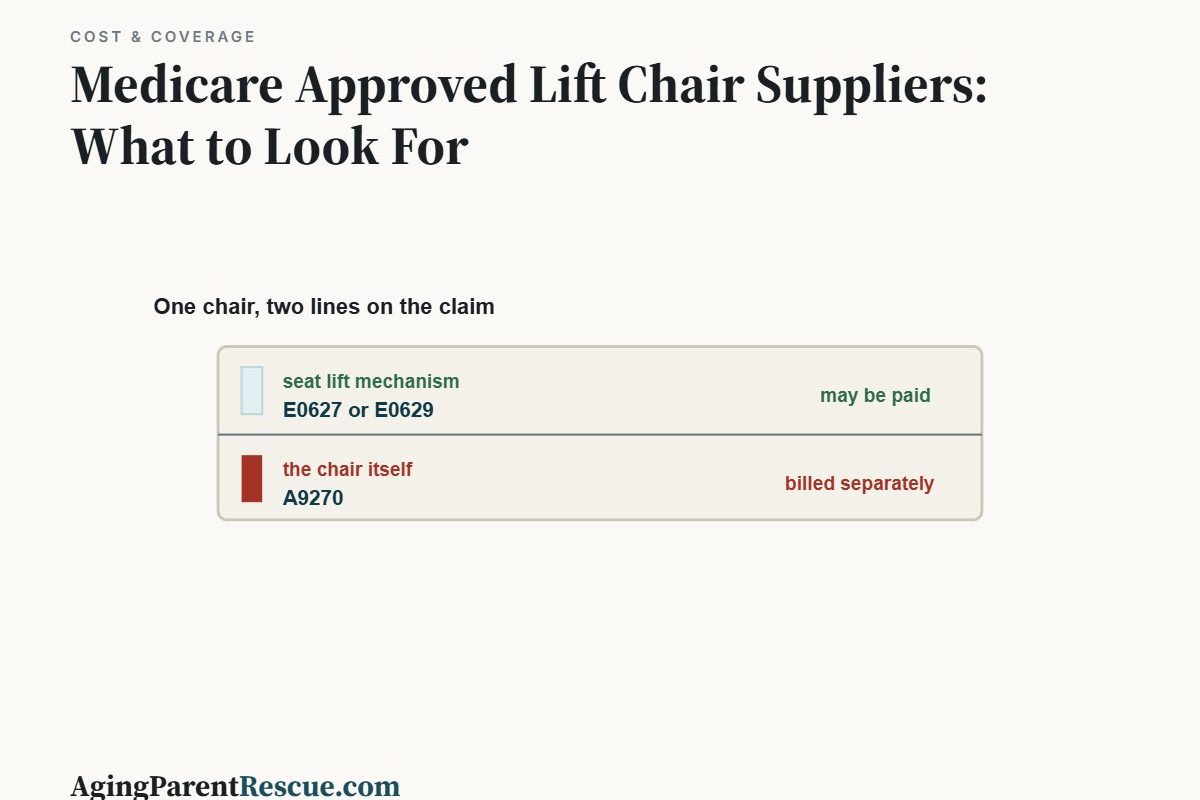
The billing codes for the seat lift mechanism — electric and manual. These are what Medicare pays toward. There is no code for an approved chair and no list of approved chairs. What exists is a list of enrolled suppliers, and that is the thing to go looking for.
CMS Policy Article A52518, Seat Lift Mechanisms, revision effective 2 July 2023.
“Medicare approved lift chair” is a phrase manufacturers use and Medicare does not. It sounds like a certification and it is not one. Understanding what replaces it saves a lot of wasted phone calls, because you stop asking retailers the wrong question.
What the paperwork actually looks like
That is why shopping for an “approved chair” goes nowhere. The covered item is a component, it has a code, and the furniture wrapped around it is on a different line of the claim. A supplier who tells you a particular chair is Medicare approved is describing the mechanism inside it, at best.
What Medicare pays on that first line is also capped: where a unit combines a recliner with the seat lift, payment is limited to what the lift alone would be worth. The full coverage rules, including the medical test that decides whether anything is paid at all, are here: are lift chairs covered by Medicare.
What you are actually looking for
Three things have to line up, and all three are about the supplier rather than the chair.
Enrolled in Medicare. If the supplier is not enrolled, the claim is not paid, whatever the prescription says and however suitable the chair is.
Accepts assignment. A supplier who accepts assignment has agreed to Medicare’s approved amount as full payment for the covered line. One who does not can charge more, and the difference is yours on top of the coinsurance.
Willing to bill Medicare directly. Some suppliers will sell you the chair and hand you the paperwork to claim yourself. That is legal and it is a much worse deal, because the work and the risk move to you.
How to find one
Start with Medicare’s own supplier tool. The durable medical equipment supplier directory at medicare.gov/medical-equipment-suppliers lets you search by postcode and equipment type, and it flags which suppliers participate. That flag is the one worth filtering on.
Or phone 1-800-MEDICARE. Slower, and better if the online tool gives you a list of names you cannot tell apart. Ask specifically for suppliers of seat lift mechanisms who accept assignment.
Then ask the prescribing doctor. Their office deals with the same handful of local suppliers constantly and knows which ones actually complete the paperwork. This is usually the fastest route and the one people skip.
What not to do is search for chairs first. Starting from a chair you like and working backwards to a supplier who will bill for it is the long way round, and it usually ends with a chair nobody will claim for.
Coverage decisions are made on the individual record, local policies vary by contractor, and nothing on this page is a promise about your claim. Do the asking before anything is delivered: once a chair is in the living room, your negotiating position is gone and returns on this kind of item are expensive. If there is any doubt about whether the person meets the medical criteria, settle that with the prescribing doctor first — the supplier cannot make that decision and should not be asked to.
Six questions, in this order
1. Are you enrolled in Medicare as a DME supplier? If no, stop here.
2. Do you accept assignment? If no, ask what the difference would be in dollars before going further.
3. Will you bill Medicare directly for the seat lift mechanism? You want yes, not “we can give you the forms”.
4. What will I pay out of pocket, all in? Ask for the chair, the mechanism coinsurance and the delivery as three numbers, not one.
5. What documentation do you need from the doctor? Get the list and take it to the surgery yourself rather than hoping two offices talk to each other.
6. Who delivers and sets it up? These chairs are heavy and often arrive in two boxes. A supplier who delivers into the room is worth real money compared with one who leaves it at the kerb.
What the doctor has to document
The supplier cannot conjure coverage from a note that says the chair would be helpful. The record has to show a qualifying condition, that the lift is part of the treatment, and that without it the person would effectively be confined to a chair or bed.
That last test is strict and it is where most claims fail. It is worth reading before the appointment so you can ask the doctor directly whether the record supports it: the medical criteria, in plain words. The same logic governs the rest of the equipment in the house: how Medicare treats home safety equipment.
If the local suppliers cannot help
This happens more often than the guides admit. The supplier may stock two chairs, neither in the size the person needs, and be unable to order the one you want and still bill for it.
At that point you are making a straightforward trade: a smaller reimbursement on a chair that fits badly, or no reimbursement on the right chair. For most households the chair matters more, because it is used several times a day for years and the reimbursement is a one-off fraction of a component.
If you go that way, buy on the measurements rather than the brand: what actually decides a power lift recliner, how to size the chair to the person, and whether you need more than three positions.
And if the reason you are dealing with suppliers at all is that the person needs a chair specified to them rather than off a shelf, that is exactly what the mobility trade is good at: the dealer brands, and what you get for the price.