Threshold Ramps: Matching the Ramp to the Rise
Aging Parent Rescue is a participant in the Amazon Services LLC Associates Program. We may earn a commission when you buy through links on our site, at no extra cost to you.
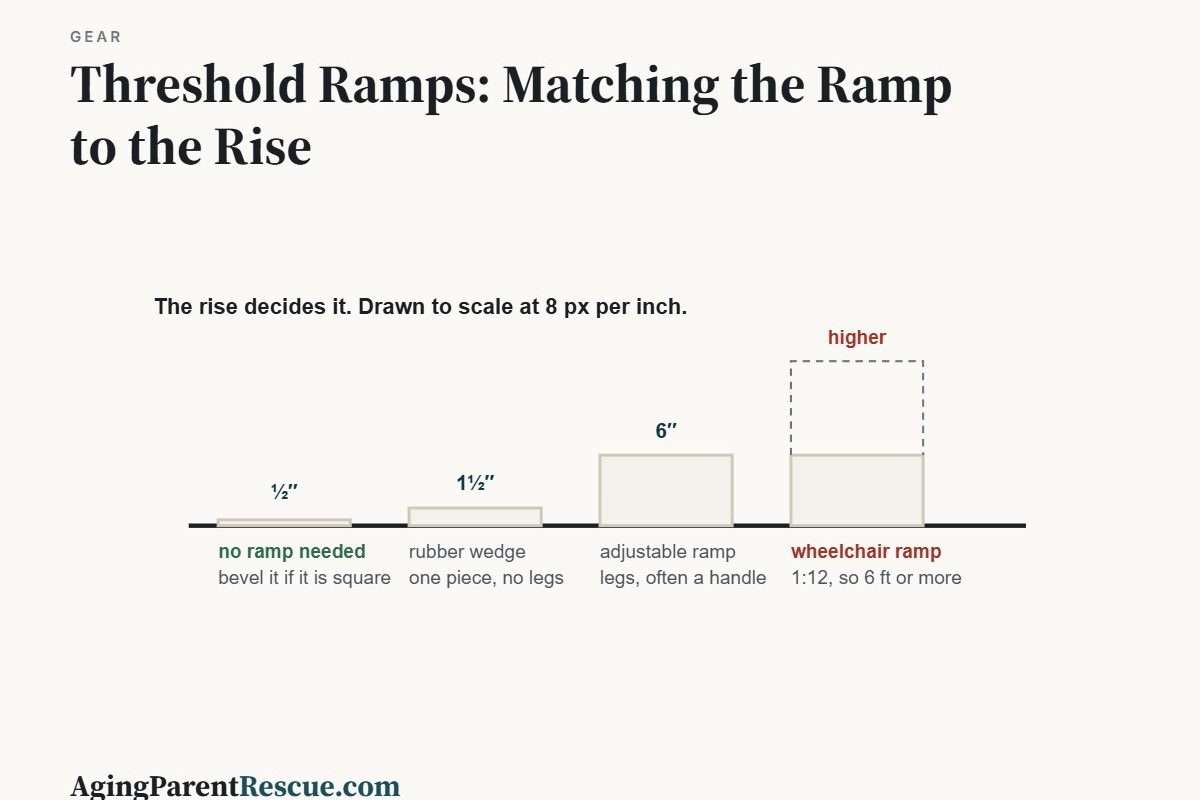
The practical ceiling for a threshold ramp. Above about six inches of rise, keeping a safe 1:12 slope needs six feet of run, and at that length you are buying a wheelchair ramp rather than a threshold ramp. Below it, the rise alone tells you which product to order.
Derived from the 1:12 slope used elsewhere on this site: 6″ of rise × 12 = 72″ of ramp.
Threshold ramps are one of the few pieces of home equipment where the choice is genuinely mechanical. There is one measurement, it takes ten seconds, and it decides the product. Everything else — rubber or aluminium, fixed or adjustable, with a handle or without — is secondary.
The measurement is the rise: the vertical height from the lower floor to the top of the lip or step. Not the depth of the threshold, not the width of the door. The rise.
Measure the rise, then read off the product
Under half an inch. No ramp. That is the height a threshold can be and still be crossed, and anything above a quarter inch should be bevelled rather than left square. Fitting a ramp here usually makes things worse by adding a second edge.
Half an inch to about an inch and a half. A one-piece wedge, rubber or aluminium, that sits against the lip. No legs, no adjustment. This covers most interior door strips and the transition into a shower room.
An inch and a half to six inches. Now you need an adjustable ramp with legs, because the run has to be long enough that the slope stays manageable, and the ramp has to sit level on ground that rarely is. This is the range most back-door steps fall into.
Above six inches. Different product. At 1:12 you need a foot of ramp for every inch, so a seven-inch step is seven feet of ramp, and the geometry stops being a threshold problem: the slope a wheelchair ramp needs and how long a ramp for two or three steps has to be.

For a door lip
Aluminium Door Threshold Ramp, 1″ Rise
The straightforward case: a single lip at a door, an inch or under. One piece, nothing to adjust, nothing to work loose. Measure the rise before ordering — these are sold by rise, and a ramp that overshoots leaves a step at the top.
- Sized for a 1″ rise rather than adjustable
- Aluminium, so it will not compress or curl in sunlight
- Slip-resistant surface rather than bare metal
Rating and review count checked on 15 September 2026. Price is not shown here because it changes; the button opens the current listing.
For a step
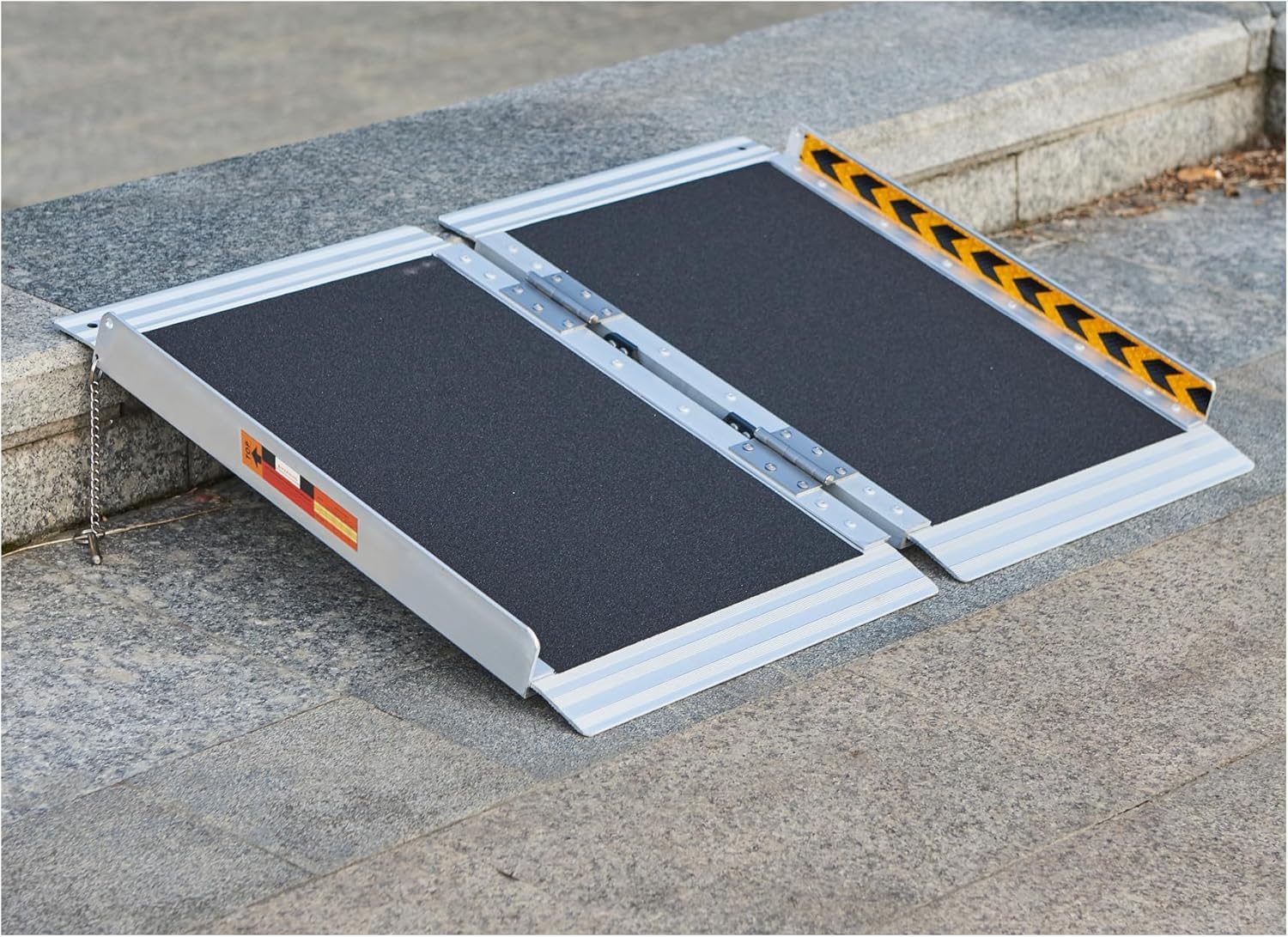
Adjustable Threshold Ramp, 2–6″ Rise
The one to buy when there is an actual step rather than a lip. Adjustable legs let you level it on a path that slopes away from the house, which is the situation that defeats fixed wedges. A carry handle matters more than it sounds if it comes in at night.
- Covers a 2–6″ rise on adjustable legs
- Rated to 800 lb, which is person plus equipment
- Handle, so one person can move it without dragging
Rating and review count checked on 15 September 2026. Price is not shown here because it changes; the button opens the current listing.
A sister model covers a 3–9″ rise. If yours is over six inches, read the slope section below before ordering it.
Rubber or aluminium
Rubber is quieter, grips a smooth floor without fixings, and tolerates an uneven surface because it deforms slightly. It is heavy for its size, which is a virtue indoors and a nuisance if it has to be moved. In full sun it gets hot and, over years, can take a set.
Aluminium is lighter, holds its shape, and is the only sensible answer outdoors or where the ramp has to span any distance. It needs a textured surface to be safe wet, and it will move on a slick floor unless it is fixed or has a rubber base.
Indoors on tile or timber, rubber. Outside, or anywhere it has to bridge more than a couple of inches, aluminium.
The sliding-door case
Patio doors are the awkward one, because the track is wide, sits proud on both sides, and the door itself runs in it. A wedge on the inside leaves the outer rail exposed; a wedge on both sides can foul the door.
What you want here is a ramp made for the track: two shallow slopes with a flat centre that clears the rail, or a pair of matched wedges sized to the track depth. Measure the rail height on both sides separately — they are often different — and check the door still closes with the ramp in place before anyone relies on it.
Two failures turn a ramp into a hazard. The first is a door that opens over the ramp: the leading edge catches, the door stops halfway, and somebody pulls harder while standing on a slope. Open and close the door fully with the ramp in place before it goes into service. The second is the run-off — the ground at the bottom of the ramp has to be flat and clear for at least the length of the equipment, or the front wheels drop off the edge sideways. If the ramp lands on gravel, grass or a path that slopes away, fix that first. This is a home-setup check; anything about whether someone should be using a ramp unaccompanied belongs with their physiotherapist or occupational therapist.
The weight rating is not about the person
Threshold ramps are typically rated 600–800 lb, and people read that as an enormous margin because they compare it to body weight. The comparison is person plus equipment plus whatever is being carried, and with a powered wheelchair the equipment is the larger half.
The other reason the number matters is dynamic load. Crossing a ramp is not a static weight sitting in the middle; it is a wheel loading a small area at the edge. Check the figure against everything that will cross it: what a portable ramp’s weight rating actually has to cover.
Small wheels are why the lip matters at all
A half-inch lip is nothing to a person walking. It is a great deal to a small wheel, because the wheel meets it at a steep angle, catches, and stops while the person keeps moving. That is the mechanism behind a lot of indoor falls involving walkers and rollators, and it is the reason a threshold ramp is often the cheapest safety fix in the house.
It is also why wheel size is worth knowing before you decide whether you need a ramp at all: 7.5-inch rollator wheels against 6-inch, and more generally how to choose a rollator.
When the ramp is not the answer
If the rise is over six inches, stop buying threshold ramps and work the geometry properly. You need the run, a level landing at the top big enough to open the door from, and usually a handrail. Those have their own numbers: the landing size at the top of a ramp and the handrail height a ramp needs.
And if the entrance is the problem rather than the threshold — a narrow porch, a door that swings the wrong way, no room for a landing — it is worth looking at the whole approach in one go rather than one parcel at a time: the entrance, step by step.