Jar Openers for Arthritic Hands: Grip, Not Strength
Aging Parent Rescue is a participant in the Amazon Services LLC Associates Program. We may earn a commission when you buy through links on our site, at no extra cost to you.
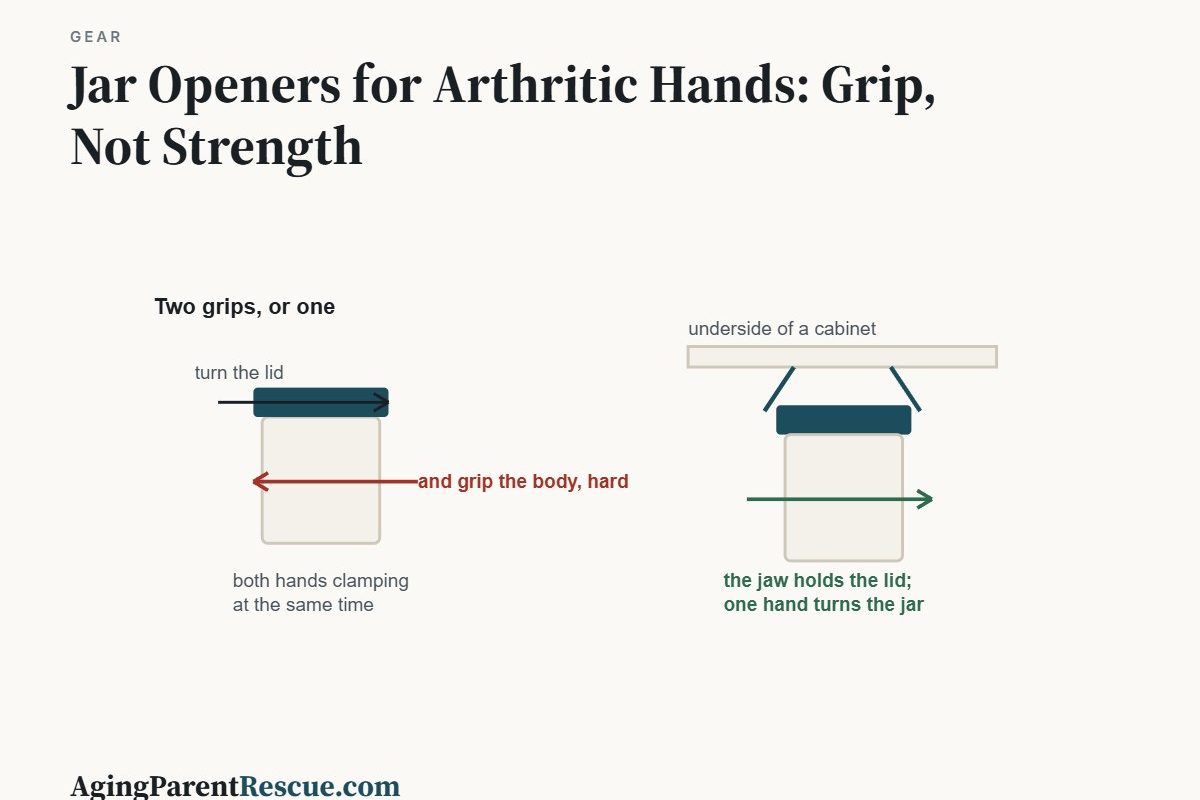
What actually fails. An arthritic or weak hand can usually still turn something; what it cannot do is squeeze hard enough to stop the jar rotating while the other hand turns the lid. Any opener that still needs two firm grips has not solved the problem — it has made it slightly easier to fail.
Opening a jar needs two opposing holds. The hand that grips the body is the one that gives out first.
This is why the rubber disc in the kitchen drawer disappoints. It genuinely increases friction, and friction was never the binding constraint. The binding constraint is that both hands have to clamp, hard, in opposite directions, at the same time.
Openers divide cleanly by whether they fix that or not.
The two-grip problem
An under-cabinet opener screws to the underside of a wall unit. You push the lid up into a V-shaped jaw, which bites and holds it, and then you turn the jar. That converts a two-grip task into a one-grip task, and the remaining grip is the easy one: a whole hand wrapped round a jar body, powered by the arm rather than the fingers.
It is the only design in common sale that works genuinely one-handed, which also makes it the right answer after a stroke or with one arm in a sling.

Best for most people
EZ Off Under-Cabinet Jar Opener
The one that actually removes the grip problem rather than reducing it, and the review depth here is unusual for a kitchen gadget. It has to be screwed up under a cabinet, which is the only real objection to it — and the reason it works.
- Holds the lid, so only one hand is needed
- Handles a wide range of lid sizes without adjustment
- Mounted, so it cannot be dropped or lost in a drawer
Rating and review count checked on 15 September 2026. Price is not shown here because it changes; the button opens the current listing.
Fit it where they already stand to open things, at a height they can reach without going on tiptoe. A jar held above shoulder height is a different problem.
Handheld lever openers
The other honest design is a lever. A long handle clamps the lid and multiplies the force, so the turning hand needs far less strength. It does not fix the holding hand — the jar still has to be steadied — but steadying is much easier than gripping, and it can often be done against the body or in a drawer edge.
These are worth having even where the under-cabinet opener is fitted, because they travel and they cope with the odd lid the fixed jaw slips on.

The one that travels
Adjustable Lever Lid Opener
A long handle and an adjustable jaw, so one tool covers everything from a jam jar to a large pickle lid. Cheap, effective on the turning side, and it still asks the other hand to hold the jar — which is the limit of the design rather than a fault in this one.
- Adjustable jaw covers most lid diameters
- Long handle, so the effort comes from the arm
- Sold under several near-identical listings — they are the same tool
Rating and review count checked on 15 September 2026. Price is not shown here because it changes; the button opens the current listing.
What to know before searching for an electric one
Search for an electric or automatic jar opener and most of what comes back is an electric can opener. They are different machines solving different problems, they sit next to each other in the results, and the listings use overlapping words. Check the pictures rather than the title: a can opener cuts a lid off a sealed tin; a jar opener grips a screw lid and rotates it.
Genuine battery-powered jar openers do exist and they suit someone with very little hand function, but there are far fewer of them, the reviews are thinner, and they are bulky to store. If a mounted opener can be fitted, fit that instead — it is simpler, has nothing to charge, and does not fail in the middle of a lid.
The things that cost nothing
Two of these work better than most gadgets and both are worth teaching before anything is bought.
Break the vacuum first. Most stubborn lids are not tight, they are held by a partial vacuum. Tap the edge of the lid firmly against a hard edge, or lever a teaspoon handle under the rim until it hisses. After that, the lid usually turns with almost no force.
Warm the lid, not the jar. Run hot tap water over the metal lid for twenty seconds while keeping the glass out of the stream. The metal expands faster than the glass and the fit loosens. Dry it before turning, because wet is the one thing that genuinely does make grip worse.
What is not worth doing is the thing people reach for first: gripping harder. That is how a jar ends up dropped, and a dropped jar on a kitchen floor is a worse afternoon than an unopened one.
When the jar is the wrong battle
If opening jars has become a daily struggle, the fix is sometimes upstream of the tool. Smaller jars, screw-top bottles instead of corks, ring-pull tins, and decanting a big jar into a small one on shopping day all remove the problem rather than making it winnable.
It is also worth noticing what the struggle is telling you. Jars going unopened, tins going uneaten and food going out of date are among the quieter signals that someone’s hands have changed more than they have mentioned: what to look for when you are there for a few days.
And if the kitchen is generally becoming harder work, the openers are one item on a longer list: the kitchen, worked through in order.