Bed Height for Elderly Parents: Feet Flat on the Floor
Aging Parent Rescue is a participant in the Amazon Services LLC Associates Program. We may earn a commission when you buy through links on our site, at no extra cost to you.
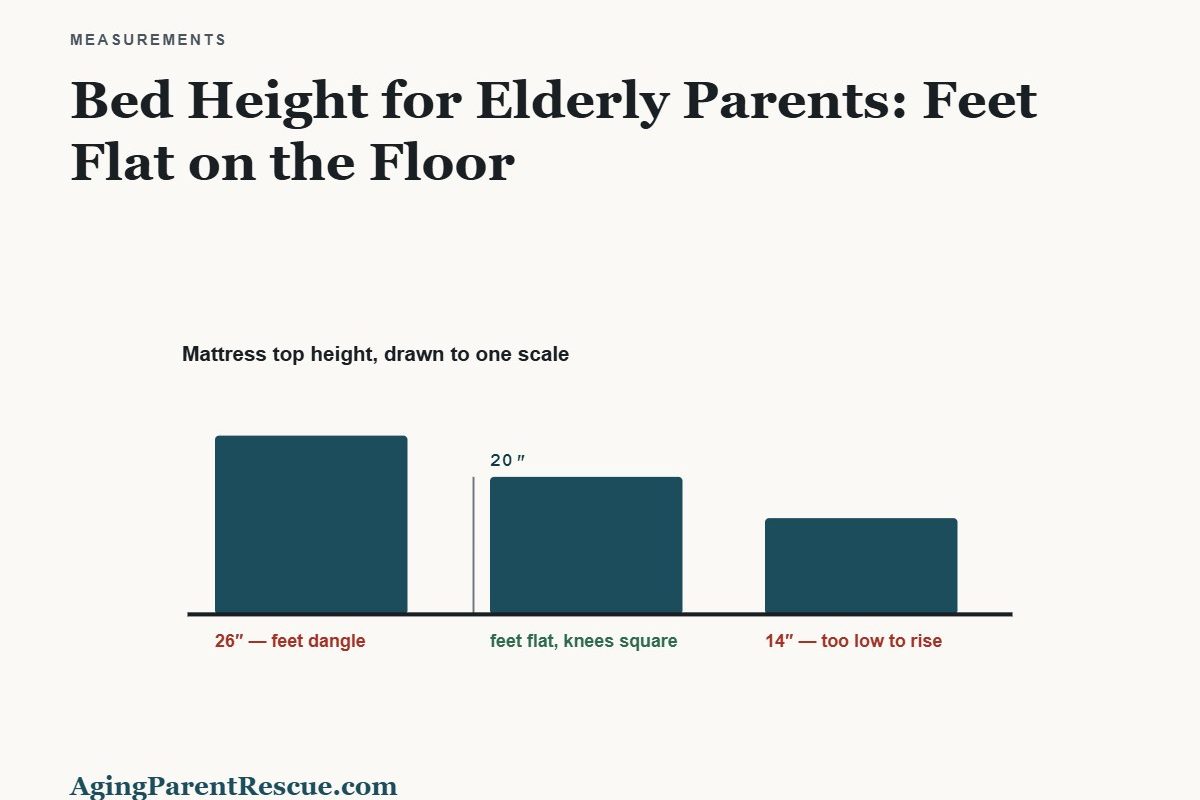
Floor to the top of the mattress, with someone sitting on it so the mattress is compressed. The real test is not the number: feet flat on the floor, knees at about a right angle, thighs level.
A little higher than a chair, because getting out of bed is a slide forward rather than a push up.
Bed height gets missed because a bed that is too high does not feel dangerous. It feels luxurious. The problem only shows at the moment someone sits on the edge at night and their feet do not find the floor.
The test that beats the number
Sit them on the edge, shoes on. Look for three things: feet flat on the floor, knees at roughly a right angle, and thighs level rather than sloping.
If the feet dangle, the bed is too high. They will shuffle forward and drop the last few inches to reach the floor, in the dark, half asleep, which is exactly the moment a hip breaks. If the knees ride up above the hips, the bed is too low and getting out becomes the same deep-squat problem as a chair that is too low.
Measure with weight on the mattress. An uncompressed pillow-top can read three inches taller than the height that actually exists.
Lowering a bed that is too high
Work down the stack, cheapest first. Remove the bed frame and stand the box spring on the floor. Remove the box spring and put the mattress on a low platform. Change the mattress — a modern 14-inch mattress on any base is already most of the problem, and an 8 to 10-inch one solves it outright.
Note that a thick mattress also makes bed rails less effective, because the rail has less exposed height above the mattress to actually hold anything in.
Raising a bed that is too low
Bed risers under the legs are the standard fix and they work, with two conditions. Every leg must sit fully inside its cup, and the risers must be rated for the load of bed plus mattress plus occupants. A riser that has crept half off its leg is a bed corner waiting to drop.
Check stability by pushing down hard on each corner in turn before anyone sleeps in it.
Hospital beds and the space around them
A standard home hospital bed is about 36″ wide and 80″ long, which is narrower than a double and usually fits where a double was. Its advantage is that the height is adjustable, so the number above stops being a fixed problem.
What people forget is the space beside it. If someone transfers to a wheelchair, you need roughly 36–42″ of clear floor on the transfer side, not the 18 inches most bedrooms leave. That usually means moving a bedside table rather than moving the bed.
A bed rail is for rolling and for something to hold while turning over. It is not a fix for a bed at the wrong height, and using one that way creates a worse hazard: someone climbing over or around a rail to reach a floor they cannot reach directly. Get the height right first, then decide whether a rail is needed. Anything about a person’s own strength, balance or medication belongs with their doctor or an occupational therapist, not with a website.
The 3am version
Whatever you measure in daylight, check it again in the dark. The route from the edge of the bed to the door is where bed height turns into a fall, and a bed at the right height with a rug edge two feet from it has not solved anything. See the bedroom checklist for the rest of that path.
If the reason you are measuring the bed is that they are sliding or rolling toward the edge, the bed height is only half the answer: which type of bed rail solves which problem.