Chair Seat Height for Elderly Parents: 17 to 19 Inches
Aging Parent Rescue is a participant in the Amazon Services LLC Associates Program. We may earn a commission when you buy through links on our site, at no extra cost to you.
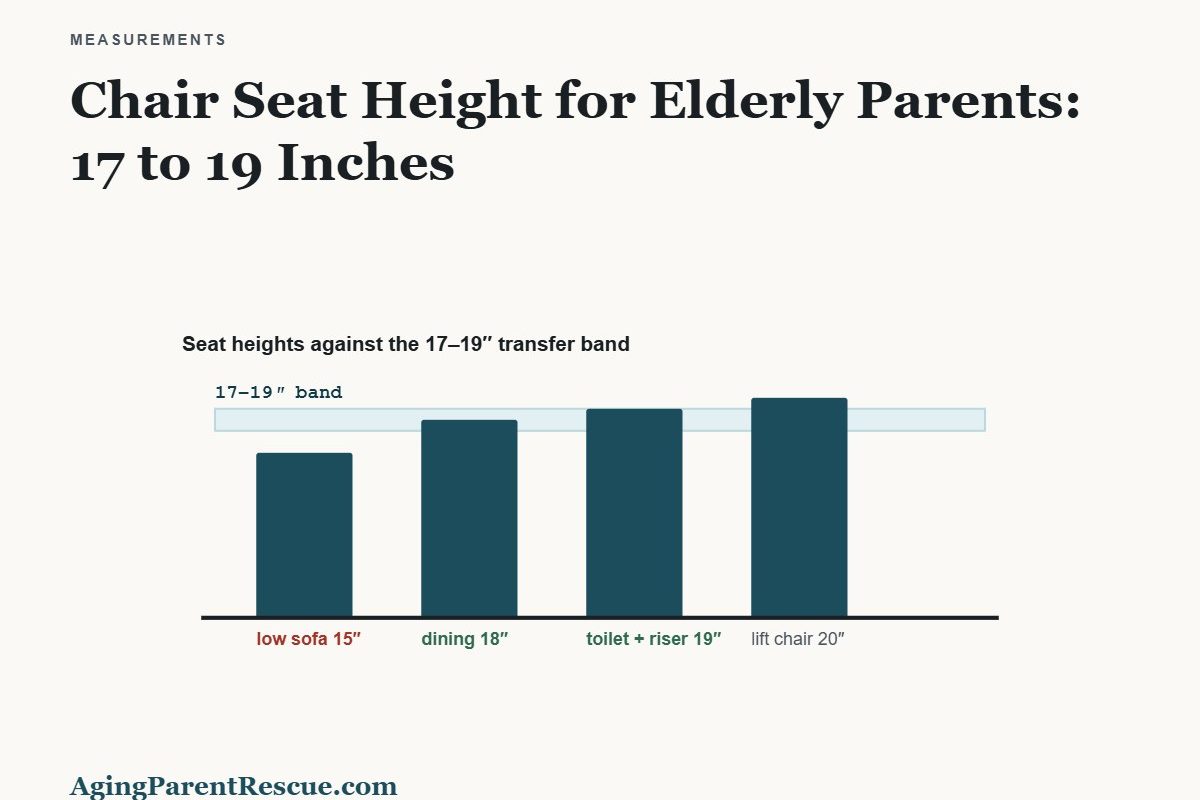
Floor to the top of the compressed cushion, not the frame. This band matches toilet and wheelchair heights, so moving between them is a sideways slide rather than a climb.
Same figure ADA uses for transfer surfaces and toilet seats.
Almost every fall-adjacent problem in a living room traces back to this number. A chair two inches too low turns standing up from something automatic into something that needs planning, a run-up, or a hand on the coffee table.
Why the band is what it is
Standing up is a knee extension under load. The lower the seat, the deeper the knee is bent at the start, and the force the thigh muscles have to produce climbs steeply as that angle closes past ninety degrees.
At 17–19″ a typical adult sits with the knees at roughly a right angle and the feet flat. That is the position the leg can push out of. Drop to 15″ and the same person is now rising out of a partial squat, which is a far harder movement and one that weakens early with age.
The second reason is transfers. A toilet at 17–19″, a shower seat in the same band and a wheelchair seat at a similar height mean the person moves across rather than up or down. Every inch of mismatch is an inch that has to be lifted.
Measure the person, then the chair
The chair should match the leg, not a standard. Have them sit on a firm surface with shoes on and feet flat, then measure from the floor to the back of the knee. That distance is their seat height.
If it lands outside 17–19″, follow the leg, not the band. A tall person with a 21-inch lower leg is not helped by a 19-inch chair, and a short person perched with dangling feet cannot push off at all because there is nothing under the feet to push against.
Measure the chair with the cushion compressed. Sit on it, then measure. An unloaded cushion can read two inches higher than the height that actually exists once someone is in it, and soft cushions are the worst offenders because they also sink unevenly.
Raising a chair that is too low
In rough order of how well they work.
A firmer cushion. Free if you have one. Replacing a collapsed foam cushion with a dense one often recovers two inches and improves the surface at the same time. A soft cushion is not just low, it is unstable, because the person sinks in and then has to escape a hollow.
Furniture risers under the legs. Cheap and effective, but check the chair does not become top-heavy and that all four legs sit fully in their cups. See the same approach applied to a bed.
A different chair. Often the honest answer. Dining chairs are usually already in the band and have arms to push against, which a sofa does not.
A correct seat height with no armrests still leaves someone pushing off their own knees or grabbing furniture that was not designed to be grabbed. Armrests that reach forward far enough to push down on, at roughly 7–9″ above the compressed seat, do more for independent standing than the last inch of seat height. Anything they habitually pull on — a table edge, a windowsill, a radiator — is a fall waiting for the day it moves.
The chair to check first
Not the armchair they sit in all evening. Check the one they get up from most often when tired: usually the kitchen chair, or the edge of the bed. Those are the transfers that happen at 3am, and they are the ones nobody measures.