Grab Bar Height: The Numbers That Actually Matter
Aging Parent Rescue is a participant in the Amazon Services LLC Associates Program. We may earn a commission when you buy through links on our site, at no extra cost to you.
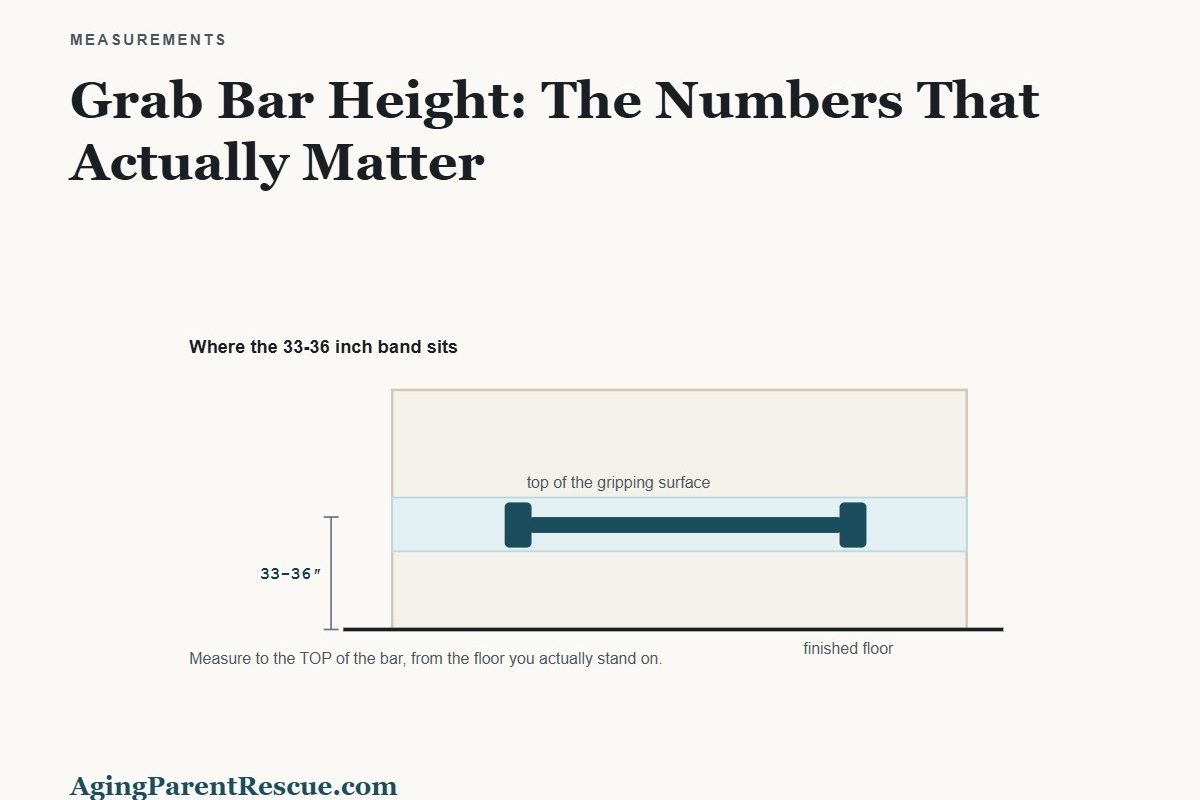
Floor to the top of the gripping surface. Measure from the finished floor — the tile you actually stand on, not the subfloor.
Figure used in ADA 604.5 and ANSI A117.1 for public and multi-family construction.
Your parent’s house is not a public building. Nobody is going to inspect it, and no code officer is going to make you move a bar two inches. So why use the number at all?
Because it was arrived at by testing how people actually push themselves up. Below 33″ the bar sits too low to help someone rise from a seated position. Above 36″ a shorter person has to reach up, which pulls them off balance in exactly the moment they were trying to stabilise.
Where it goes in a tub
Two bars, not one. A horizontal bar on the long back wall at 33–36″ for moving along the tub, and a vertical bar near the faucet end, bottom edge about 32″ up, for stepping in and out. The vertical one is the bar people forget, and it is the one that matters at the moment of highest risk.
Where it goes in a walk-in shower
Same 33–36″ on the back wall. If there is a seat, add a bar on the side wall within reach of the seated position — roughly 6–12″ above the seat, not at standing height.
Where it goes by the toilet
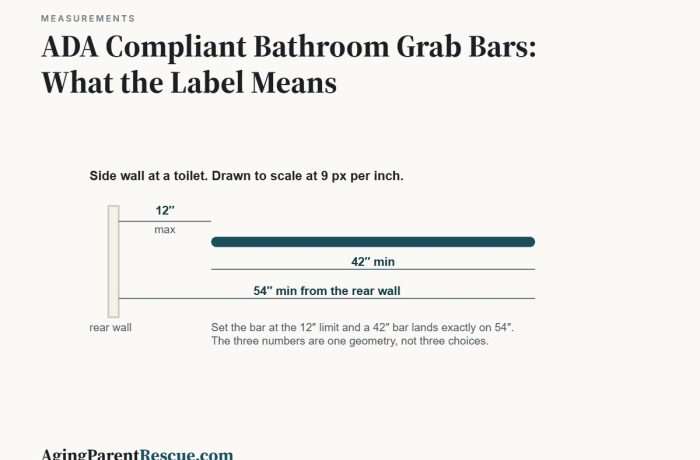
Side wall bar at 33–36″, positioned so the front end reaches at least 54″ from the back wall. Toilets are where most bathroom transfers happen and where a badly placed bar is most obvious.
Three times 33–36 inches is the wrong answer
- A very tall or very short user. The range is built around average standing height. Have them stand naturally, let the arm hang, and put the bar near wrist height. Then check it against the range and split the difference.
- A wheelchair user transferring sideways. The useful height is relative to the seat, not the floor.
- Someone who mainly needs to pull up from sitting. A vertical bar beats a horizontal one at any height, because the hand can choose its own level.
Height is the easy half. A bar at the perfect height that is anchored into nothing is worse than no bar, because it invites weight it cannot take. The bar and its anchors have to hold 250 lbf. Into studs where you can; into rated hollow-wall anchors where you cannot. Never a suction-cup bar for bearing weight.
How to measure it without a helper
Run a strip of painter’s tape up the wall, mark the floor line, then mark 33″ and 36″. Have them stand where they would really stand — wet floor, one hand on the wall — and reach. The tape tells you in ten seconds what a spec sheet cannot.
This figure comes from the same standard that governs the bars themselves, and it is worth knowing what the rest of it says before buying: what “ADA compliant” means on a grab bar listing.