How Long a Ramp Do You Need? Start With the Rise
Aging Parent Rescue is a participant in the Amazon Services LLC Associates Program. We may earn a commission when you buy through links on our site, at no extra cost to you.
Every 1 inch of vertical rise needs 12 inches of ramp. A 21-inch rise — a typical three-step porch — needs 21 ft of ramp.
Slope used in ADA 405.2 and ANSI A117.1. Not binding on a private home; it is the slope a person can actually self-propel up.
Measure the total rise: from the ground to the top of the threshold, in one straight vertical line. Not the length of the existing steps, not one step multiplied by three. Steps are rarely equal, and the last one into the house is usually taller.
The four slopes, and who each one is for
| Slope | Use it when | 21″ rise needs |
|---|---|---|
| 1:20 | Self-propelling, weak arms, or icy climates | 35 ft |
| 1:12 | The default. Self-propelling with reasonable strength, or an attendant pushing | 21 ft |
| 2:12 | Attendant pushing only, short temporary ramp | 10.5 ft |
| 3:12 | Powered scooter or wheelchair only. Never self-propelled | 7 ft |
The landing rule people skip
A single ramp run may not climb more than 30″ of rise before it needs a level landing. Landings are also required at the top, at the bottom, and anywhere the ramp changes direction — and a landing is 5 ft × 5 ft, big enough to stop, rest, and turn without rolling backwards.
This is why a 21-foot ramp rarely runs in a straight line off a porch. It switches back. Two 11-foot runs with a landing between them fits a yard that a straight 21-foot run does not.
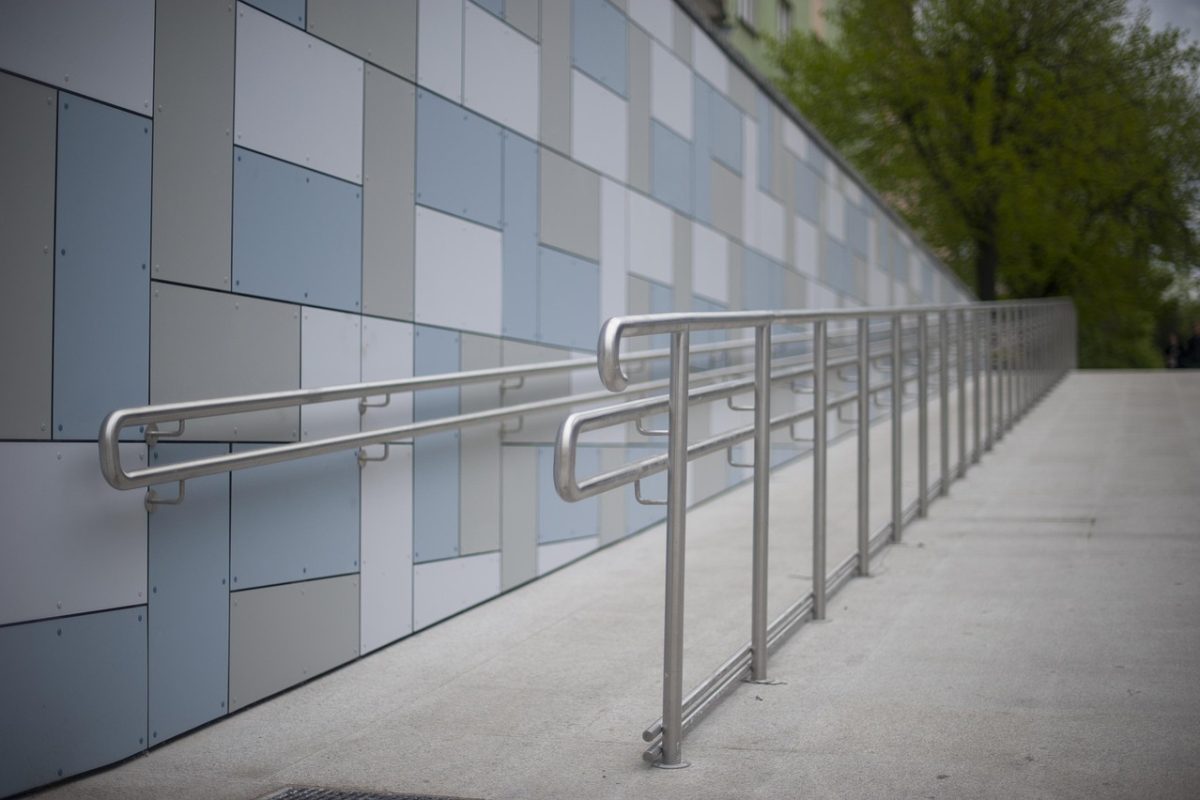
A ramp needs edge protection — a raised lip or curb — so a caster cannot run off the side. Any ramp with more than 6″ of rise should have handrails on both sides. A ramp without edges is a fall waiting for a wet day.
Threshold ramps are a different product
For a single step or a raised door sill — 1″ to 6″ — you want a threshold ramp, not a folding ramp. They sit tight to the door, they do not move when a walker hits them, and they do not need handrails.
Do the arithmetic before you shop
Ramp listings are sold by length, not by the rise they handle. A “10-foot ramp” is only right if your rise is 10 inches. Measure first, then buy.
ADA slope, handicap slope, accessible slope: one number, three names
People search this figure under several names and they all land on the same place. ADA ramp slope, handicap ramp slope, accessible ramp slope and wheelchair ramp incline are the same 1:12 maximum, written in the same document.
The only thing that genuinely changes is whether that document applies to you. It does not apply to a private home — see what the ADA actually reaches. Use the number because it was measured on real people, not because a rule compels you.
Two related figures people go looking for at the same time: how long the ramp has to be for a given rise, and how big the landings must be.
For the small rises — a door lip, a single step — a full ramp is the wrong product: threshold ramps, and the six-inch point where they stop working.