Is ADA Required in a Private Home? No, and Here Is What Is
Aging Parent Rescue is a participant in the Amazon Services LLC Associates Program. We may earn a commission when you buy through links on our site, at no extra cost to you.
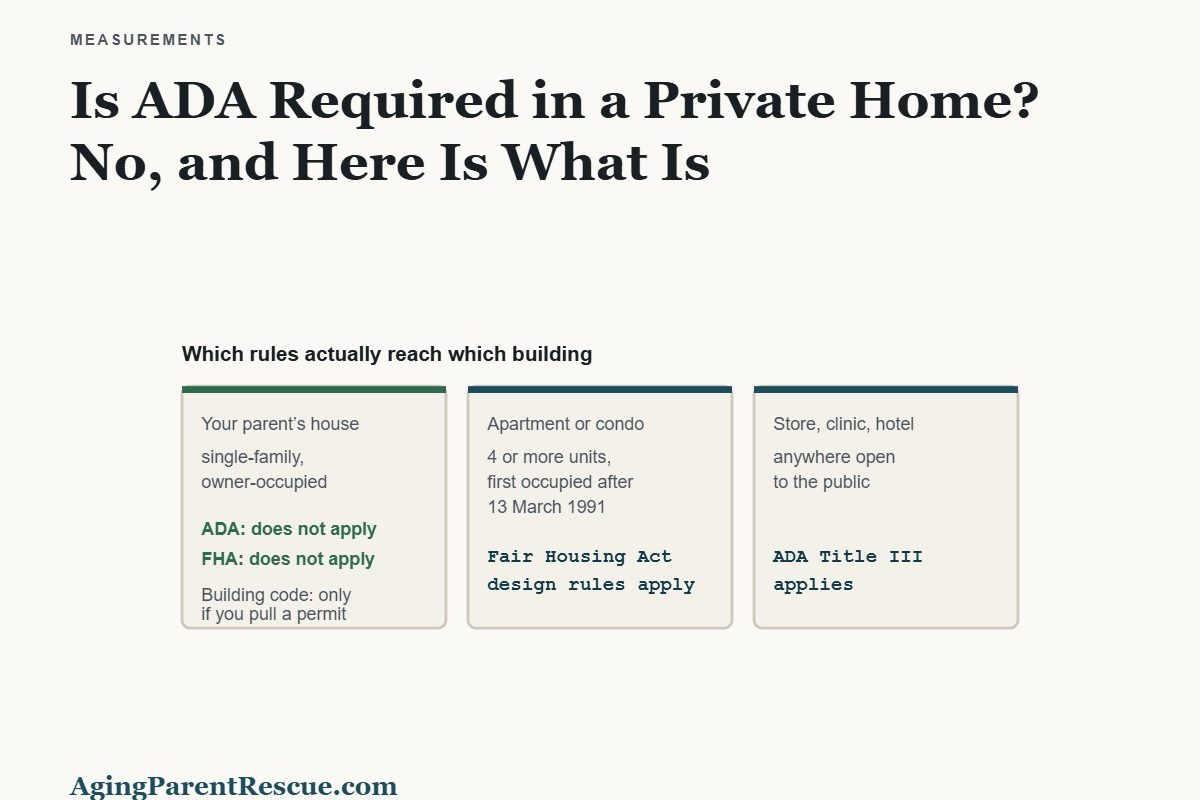
The ADA does not apply to a private home. Nobody will inspect your parent’s bathroom, and no grab bar height is legally required of you. Every number on this site is a design figure, not a rule you are breaking.
ADA Titles II and III cover government programs and places open to the public. A private residence is neither.
This question comes up constantly, usually in the form “is my dad’s bathroom up to ADA?” The honest answer is that the question does not apply. Here is what each set of rules actually covers, and why the numbers are still worth following.
What the ADA covers
The Americans with Disabilities Act reaches two kinds of places. Title II covers programs run by state and local government. Title III covers public accommodations and commercial facilities, which is the legal phrase for stores, restaurants, hotels, offices, clinics, theatres and the rest of the places anyone can walk into.
A private house that a family lives in is not a public accommodation. It is not covered, and there is no enforcement mechanism pointed at it. The one narrow exception is a room used commercially, such as a home office that clients visit, and even then it is only that portion.
What the Fair Housing Act covers
The Fair Housing Act is the one people confuse with the ADA, and it is the one that actually touches housing. Its design and construction requirements apply to covered multifamily dwellings: buildings of four or more units, first occupied after 13 March 1991. In buildings without an elevator it reaches the ground-floor units; in buildings with one it reaches every unit.
Those requirements are also more modest than people expect. They cover things like an accessible route into the unit, doors wide enough to pass through, and bathroom walls reinforced so a grab bar can be added later. The Act does not require the grab bar to be there.
Separately, the Act protects a tenant’s right to make reasonable modifications at their own expense. If your parent rents, that is the provision that matters, not any construction standard.
So where do the numbers come from
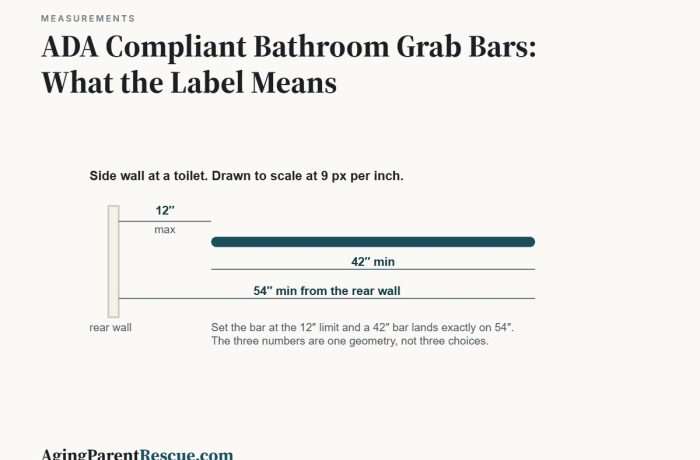
Mostly from two documents. The 2010 ADA Standards for Accessible Design is where figures like the 33–36″ grab bar band and the 32″ clear door width are written down. ANSI A117.1 is the technical standard that model building codes reference, and it is the closer relative of anything your local code enforces.
Both were built from measurements of how people with limited strength, reach and balance actually move. That is the reason to use them. Not because a rule says so, but because they are the best-tested dimensions available and someone else already did the work of finding out what fails.
Local building code is the one that can genuinely bind you, and only when you pull a permit. Widening a doorway, moving a wall, changing a stair, converting a tub to a curbless shower — all of these can trigger inspection against whatever code your jurisdiction has adopted. Codes differ by state and city. Ask your building department before the work, not after.
Why this matters for how you read the rest of this site
Two practical consequences.
First, you are allowed to deviate. The 33–36″ band is written for a public restroom serving strangers of every height. You are fitting one specific person. If they are unusually tall or short, or if they push up rather than pull across, the right height for them may sit outside that band, and that is a legitimate choice rather than a violation. The band tells you where to start, not where you must end.
Second, be careful with anyone selling to you on this basis. “ADA-compliant” on a product listing is a marketing phrase, not a certification, and it has no bearing on your house. What matters for a grab bar is whether it is rated to hold 250 lbf and whether the wall behind it can carry that load. Those are physical questions with real answers, and no law is involved in either one.
Universal design is a different idea again
Universal design is not a code and has no numbers to comply with. It is a design philosophy: make things usable by as many people as possible without needing a special adaptation. Lever door handles rather than round knobs, a curbless shower, a bench in the entry to sit on while taking off boots.
It is worth knowing the distinction because it changes what you buy. Accessible design retrofits a house for a person who already has a limitation. Universal design builds a house that never needed the retrofit. If you are planning a renovation anyway, the second one is usually cheaper than doing the first one twice.
The dimensions are still the best guidance available, and they are worth copying even though nothing requires it: the ADA grab bar numbers, and what the label on the box does not tell you.