Walker, Rollator and Wheelchair Widths: Measure the Device First
Aging Parent Rescue is a participant in the Amazon Services LLC Associates Program. We may earn a commission when you buy through links on our site, at no extra cost to you.
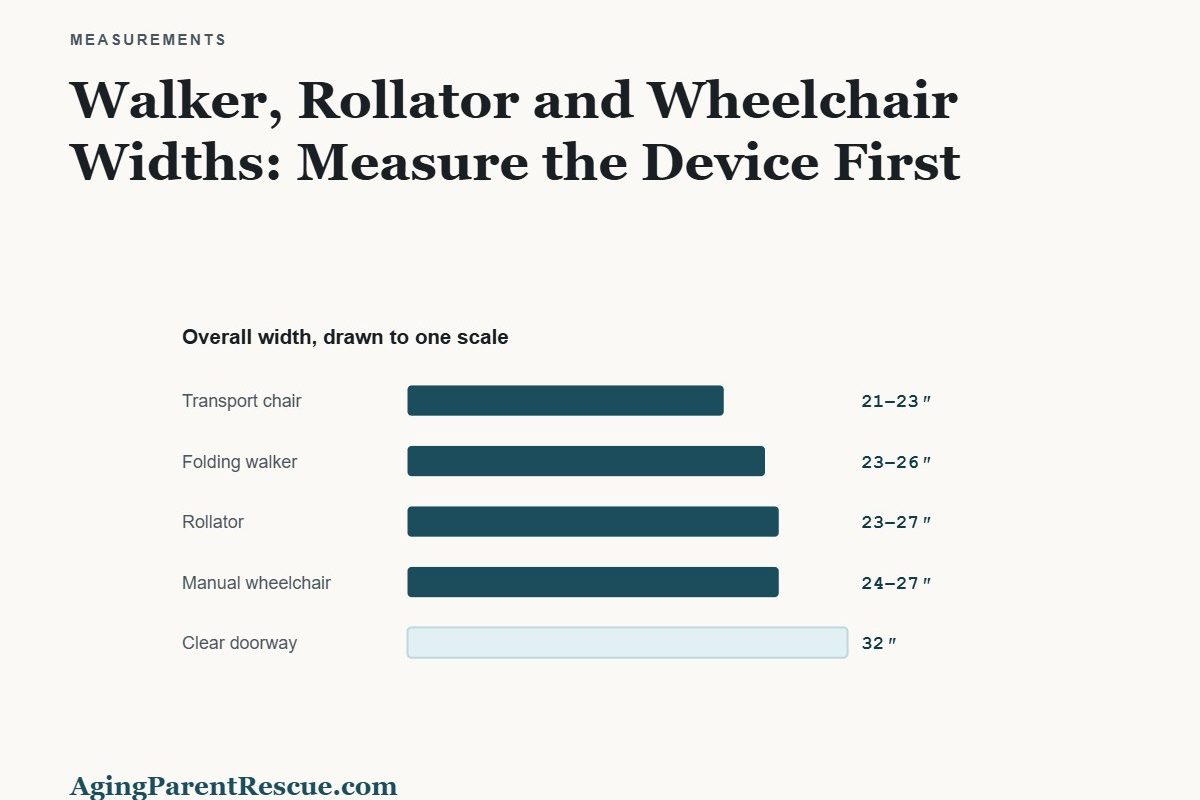
Overall width of most adult walkers, rollators and manual wheelchairs, measured at the widest point. That is usually the push-rim handles or the rear wheels, not the seat.
Ranges across common consumer models. Bariatric equipment runs wider — measure the actual device.
This number gets asked in the wrong order. People measure the doorway first and then wonder whether the chair fits. Measure the device first, because it is the fixed object — you can widen a door, you cannot narrow a wheelchair.
How to measure it properly
Open or unfold the device the way it is actually used. Then measure the widest point across, at the height where that widest point sits.
For a manual wheelchair that is almost always the hand rims, which stick out past the tyres by an inch or so on each side. Measuring the seat gives you a number four to eight inches too small, and that error is exactly the size that turns a comfortable fit into a scraped doorframe. For a rollator it is usually the rear wheels or the handgrips, whichever flares wider.
Write the number on a piece of tape stuck to the frame. You will need it again for every doorway, every bathroom and every ramp landing in the house.
The numbers by device
Transport chairs run 21–23″. They are the narrowest because they have small wheels and no hand rims — someone else pushes. That is the trade: narrow and light, but the person in it cannot move themselves.
Folding walkers run 23–26″. Wide-base and bariatric models go past that.
Rollators run 23–27″. Models sold as narrow or slim sit near 21–22″, and they are worth knowing about if the house has old doors. See rollators for narrow doorways.
Manual wheelchairs run 24–27″ for standard adult sizes. A useful rule: overall width is roughly the seat width plus 8″. So an 18-inch seat lands around 26 inches overall. Bariatric chairs start near 28″ and go well beyond.
Why fitting the doorway is not the same as getting through it
Compare your number against the clear width of the doorway, not the size of the door slab. Clear width is what is left when the door is open at 90 degrees, and the slab, hinges and stop eat one to two inches of it.
But the real failure is rarely the opening itself. It is the approach. Going through a door straight on needs only the width of the device. Turning into a door from a hallway needs far more room, because the chair has to swing. That is why a chair that measures 25 inches gets stuck in a 32-inch doorway at the end of a narrow hall, and the same chair sails through the identical door off a wide landing.
If a doorway is failing, measure the hallway it opens off before you assume the door is the problem. Widening the wrong one is an expensive mistake.
Measure with the person in it and with whatever normally hangs off it — a bag on the handles, an oxygen carrier, a cushion that spills over the sides. A rollator basket adds nothing to the frame width but a tote bag hooked over one handle can add three inches on one side and it is the side that hits the doorframe.
What to do when it does not fit
In rough order of cost. Swapping to a narrower device is cheapest and often enough, particularly indoors where a transport chair may do the job. Removing the door and its stop entirely buys an inch or two and costs nothing. Swing-clear offset hinges let the door swing fully out of the opening and typically recover around 1.5–2″ for the price of a pair of hinges. Actually widening the framed opening is last, because it means structural work, and see whether any rules apply to a private home before someone tells you it must be done to a standard.