Grab Bar Distance From Wall: Why 1½ Inches, Exactly
Aging Parent Rescue is a participant in the Amazon Services LLC Associates Program. We may earn a commission when you buy through links on our site, at no extra cost to you.
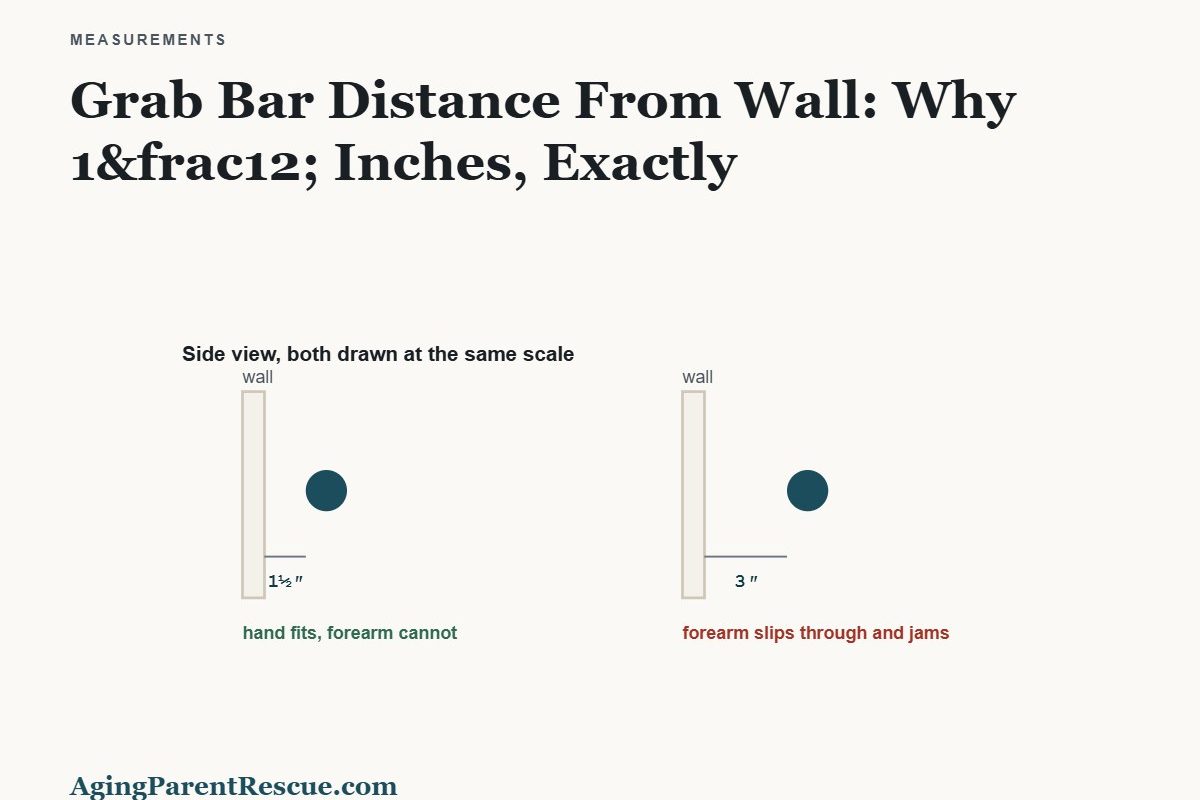
Clear gap between the back of the bar and the finished wall surface. This one is a target, not a range — both directions of error are bad, for different reasons.
Figure from ADA 609.3. Most bars ship with flanges that produce it automatically.
Almost nobody sets this deliberately, because a decent bar arrives with the right offset built into its flanges. It becomes a live decision only when something changes the wall surface, and that is exactly when it goes wrong.
What happens when the gap is too small
Below about 1¼″ your knuckles start hitting the wall. You end up gripping with fingertips instead of a closed hand, which is the same failure as a bar that is too thick to wrap your hand around: it looks like a grip and behaves like a touch.
Worse, people adapt by holding the bar from below or from the front rather than wrapping it, and neither position survives a real slip.
What happens when the gap is too large
This is the one that surprises people. Past roughly 2″ the opening becomes big enough for a forearm to pass through. In a fall the arm drops into that space, the body keeps going down, and the arm is trapped between the bar and the wall with the person’s weight rotating around it.
The injury is a twisted or broken forearm on top of the fall you were trying to prevent. A hand-sized gap catches your hand. An arm-sized gap catches your arm.
The three ways it drifts in practice
Tile and backer added after the bar was planned. New tile over old wall pushes the finished surface out toward the bar, shrinking the gap. Mount to the finished surface, and measure from the tile face, not the substrate.
Spacers behind the flange. Someone hits an uneven wall and shims the flange out to make it sit flat. Every washer added grows the gap and also puts the screws into bending rather than straight tension, which reduces the real capacity.
Mounting over trim or a soap niche edge. The flange lands on a raised edge, one end stands proud, and the bar ends up neither parallel to the wall nor at a consistent gap along its length. Move the bar rather than fight the trim.
Slide a stack of quarters or a folded tape between bar and wall at both ends and in the middle. If the three readings differ, the bar is not parallel and one flange is carrying more than its share. And whatever the gap measures, the bar still has to be anchored into structure and rated to 250 lbf — a perfect gap on a drywall-only fixing is a perfectly positioned failure.
Above and below the bar
The same logic applies to what sits near the bar, not just behind it. Keep roughly 1½″ clear below so fingers are not pinched against a ledge, shelf or tub rim, and leave the space above the bar open so the hand can approach from the top. A bar tucked under a shelf can only be gripped from one awkward angle, and in an emergency people grab at whatever is nearest without choosing an angle at all.