Grab Bar Mounting Angle: Horizontal, Vertical or Diagonal
Aging Parent Rescue is a participant in the Amazon Services LLC Associates Program. We may earn a commission when you buy through links on our site, at no extra cost to you.
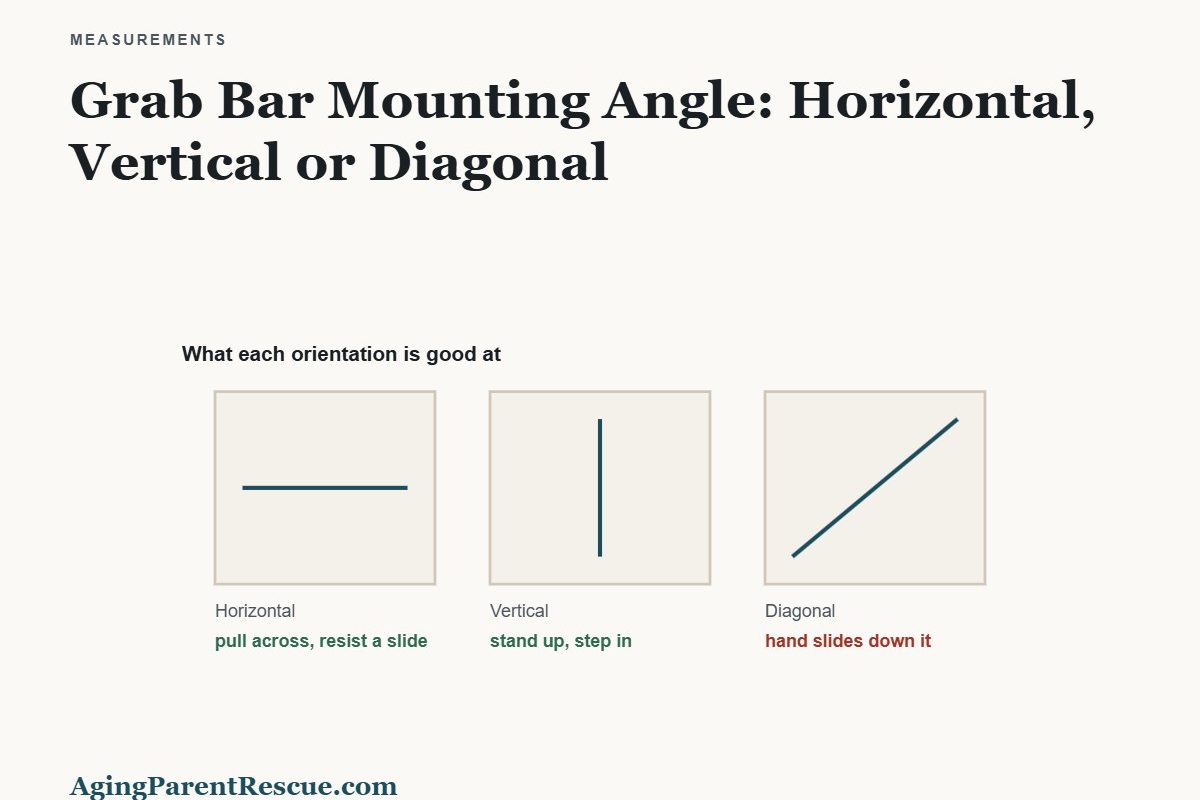
Horizontal is the default and the one to use if you install only one bar. Add a vertical bar at the entry point if you can fit a second. Diagonal is a compromise that gives up the main advantage of both.
ADA specifies horizontal bars. ANSI A117.1 additionally calls for a vertical bar in certain tub and shower layouts.
Angle decides which direction of force the bar is good at. Most people choose it by eye, and the eye picks whatever looks tidiest on the tile. The body has different preferences.
Horizontal: the one to install first
A horizontal bar is what you want when the danger is your feet going sideways. Your hand can slide freely along it while your body moves, and it resists a downward pull anywhere along its length without your grip position mattering.
That covers the two commonest moments: walking along a wet tub floor, and lowering yourself onto a seat. It is also the easiest to install correctly, because a horizontal run crosses studs at right angles so both ends can land on structure.
Vertical: for standing up and stepping over
A vertical bar answers a different question. When someone is rising from a seat or lifting one leg over a tub wall, the useful force is straight down through a bar they can pull themselves up against, and their hand needs to travel up as the body rises.
On a horizontal bar that same movement forces the wrist into an increasingly awkward angle as the body goes up. On a vertical bar the wrist stays neutral the whole way. This is why the best single addition to a tub is often not a second horizontal bar but a short vertical one near the entry.
Diagonal: why it is everywhere and still wrong
Diagonal bars are common in homes for two reasons. They look like a compromise between the other two, and they are easy to fix because a diagonal run will hit studs somewhere no matter where you start.
The problem is grip behaviour under load. On a diagonal bar a wet or weakening hand slides downhill, and it does so exactly when weight comes onto it. A horizontal bar lets the hand slide too, but sideways, where sliding does not cost you height. On a diagonal, sliding means falling.
They are not useless. A diagonal bar suits someone who reliably pulls along its line, and some people find the intermediate angle easier on the shoulder. But it should be a considered choice for a particular person, not the default because it fits the studs.
Where to put which
In a tub, a long horizontal bar along the back wall covers the length of the transfer, and a vertical bar on the control-end wall covers the step over. In a walk-in shower, horizontal on the long wall and vertical at the entry. Beside a toilet, horizontal on the side wall for pushing across, and vertical if the person rises more than they slide.
Whatever the angle, the height and the gap to the wall still apply, and a vertical bar has one extra consideration: its usable range is limited by how far the hand can reach up and down, so a short vertical bar mounted too high is reachable only by someone already standing.
A diagonal or vertical bar loads its two flanges unequally, with the lower one taking more of a downward pull. Both ends still need to be in structure, and the bar still needs to be rated to 250 lbf. If only one end lands on a stud, move the bar rather than trusting an anchor to carry the difference.