Grab Bar Length and Diameter: What Your Hand Can Actually Hold
Aging Parent Rescue is a participant in the Amazon Services LLC Associates Program. We may earn a commission when you buy through links on our site, at no extra cost to you.
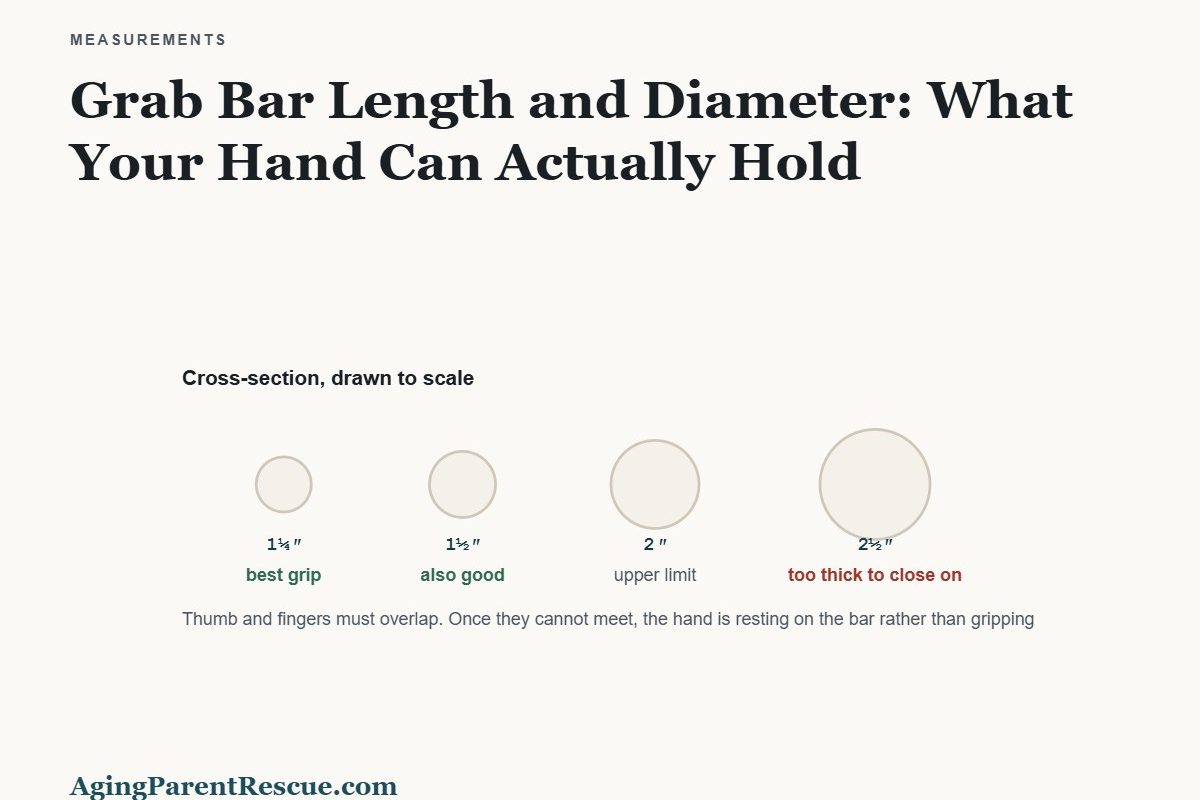
Outside diameter of the bar itself. Thin enough that your thumb and fingers overlap, thick enough not to cut into your palm. Length is a separate decision, driven by where the person loses balance.
Diameter figure from ADA 609.2.1. Non-circular bars are handled by perimeter instead.
Height gets all the attention and diameter gets almost none, which is backwards. A bar at a slightly wrong height is still usable. A bar too thick to close your hand around is not a grab bar at all, whatever the packaging says.
Why 1¼ to 1½ inches wins
The thing you need in a slip is a power grip: fingers wrapped past the far side of the bar, thumb coming round to meet them. That closed loop is what lets you hold on when your feet have already gone. An open hand pressing down on a surface does almost nothing once you are falling.
At 1¼″ almost every adult hand closes comfortably. At 1½″ most still do, and the extra thickness spreads load across the palm, which matters for arthritic hands. Past 2″ the loop opens up, and for someone with small hands or limited finger movement it never closes at all.
This is also why a towel bar is not a substitute even when it is anchored well. Many are flat or square-edged, so there is nothing to wrap around, and the edge concentrates all the load onto one line across your fingers.
What about square and oval bars
They are allowed and some are excellent. The measurement changes: instead of diameter you check the perimeter, which should land between 4″ and 4.8″ or so, with no single cross-section dimension over 2″.
Practically: wrap a strip of paper around it, mark where it meets, measure the strip. If the bar has sharp corners, skip it regardless of the numbers. Corners hurt under load and a hand in pain lets go.
Choosing the length
Length is not about the wall, it is about the distance the person’s hand travels while they are unsteady. Longer is almost always better, and the usual mistake is buying too short because it looks tidier.
Rough guide. A 12–16″ bar is a single-grip assist: getting up off the toilet, one hand, one position. An 18–24″ bar lets the hand slide along as the body moves, which is what you want beside a toilet or at a shower entry. A 32–42″ bar spans a tub or shower wall so there is something to hold at every point of the transfer, and that is the one people wish they had bought.
Two practical constraints. The bar must land on real structure at both ends, so the available stud positions may set your length before your preference does. And it should not stop short of where the feet are most likely to slide, which in a tub is the far end, not the middle.
A longer bar does not hold more. Capacity comes from the anchors and the structure behind them, and every bar someone puts weight on should be rated to 250 lbf and fixed into blocking or studs. A 36-inch bar screwed into drywall alone is more dangerous than a 12-inch bar done properly, because it invites more confident use. See what the capacity figure actually means.
How to check a bar before you buy it
Close your own hand around it in the shop, or around a pipe of the stated diameter at home. If your thumb does not reach your fingers, it is too thick for you and it will be much too thick for a weaker hand. Then check the stated load rating and the mounting flange size, because a small flange with two screw holes cannot carry a rated load no matter what the box claims.