Threshold Height: When a Door Sill Becomes a Trip Hazard
Aging Parent Rescue is a participant in the Amazon Services LLC Associates Program. We may earn a commission when you buy through links on our site, at no extra cost to you.
Maximum height for a threshold to be crossed without a ramp. Above ¼” it should be bevelled rather than square.
ADA 303 changes in level and 404.2.5 thresholds.
A half inch sounds like nothing. It is the height at which a walker foot or a wheelchair caster stops catching and starts rolling over, and it is also the height at which a shuffling foot stops catching the edge.
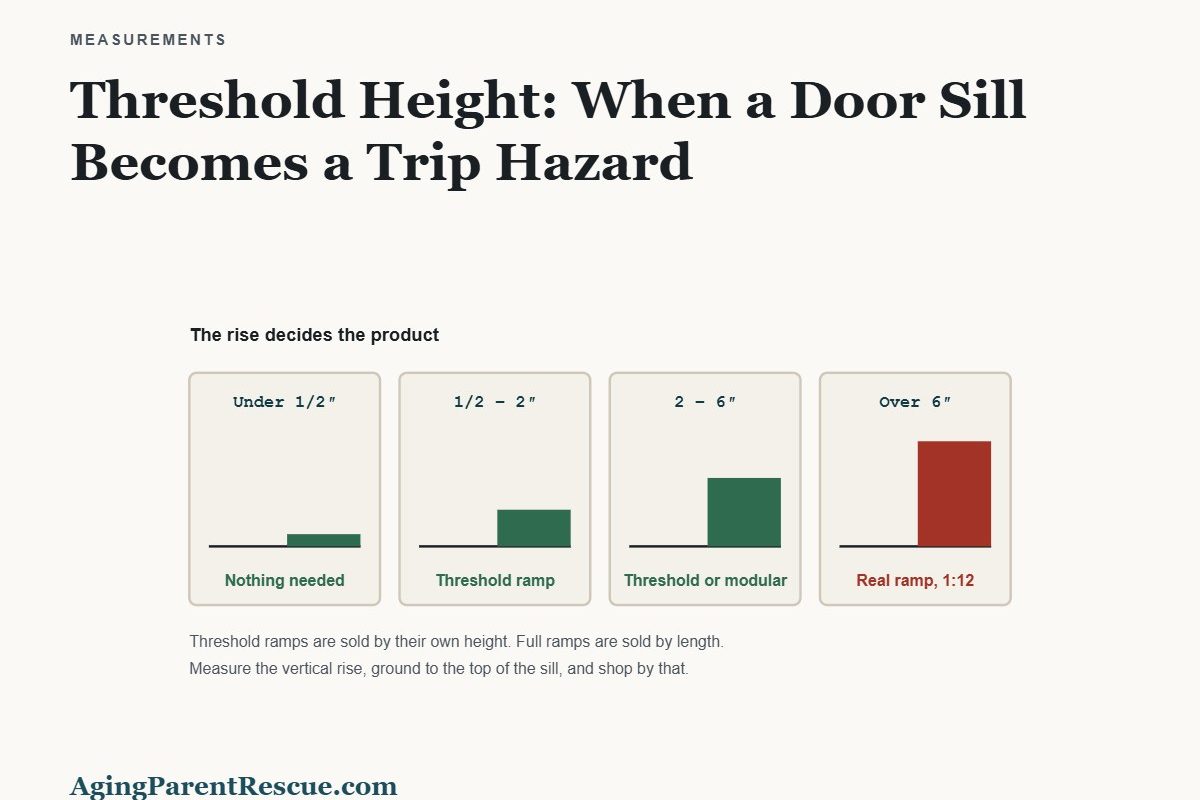
Which product for which height
| Rise | What you need |
|---|---|
| Under ½” | Nothing, if the edge is bevelled |
| ½–2″ | Threshold ramp, one side or both |
| 2–6″ | Threshold ramp, or a short modular ramp with edge protection |
| Over 6″ | A real ramp. Apply 1:12 and expect handrails |
Measure the rise, not the ramp
Threshold ramps are sold by their own height, which is what you want — but full ramps are sold by length, which is not. Measure the vertical rise from the ground to the top of the sill and shop by that number.
Patio door tracks are a special case: they are usually deep, wide, and impossible to bevel. They need a purpose-made track ramp on both sides, not a single wedge.
Where the lip is above this height, the answer is a ramp, and the rise decides which kind: matching a threshold ramp to the rise.