How Long a Ramp for 2 or 3 Steps? Longer Than You Think
Aging Parent Rescue is a participant in the Amazon Services LLC Associates Program. We may earn a commission when you buy through links on our site, at no extra cost to you.
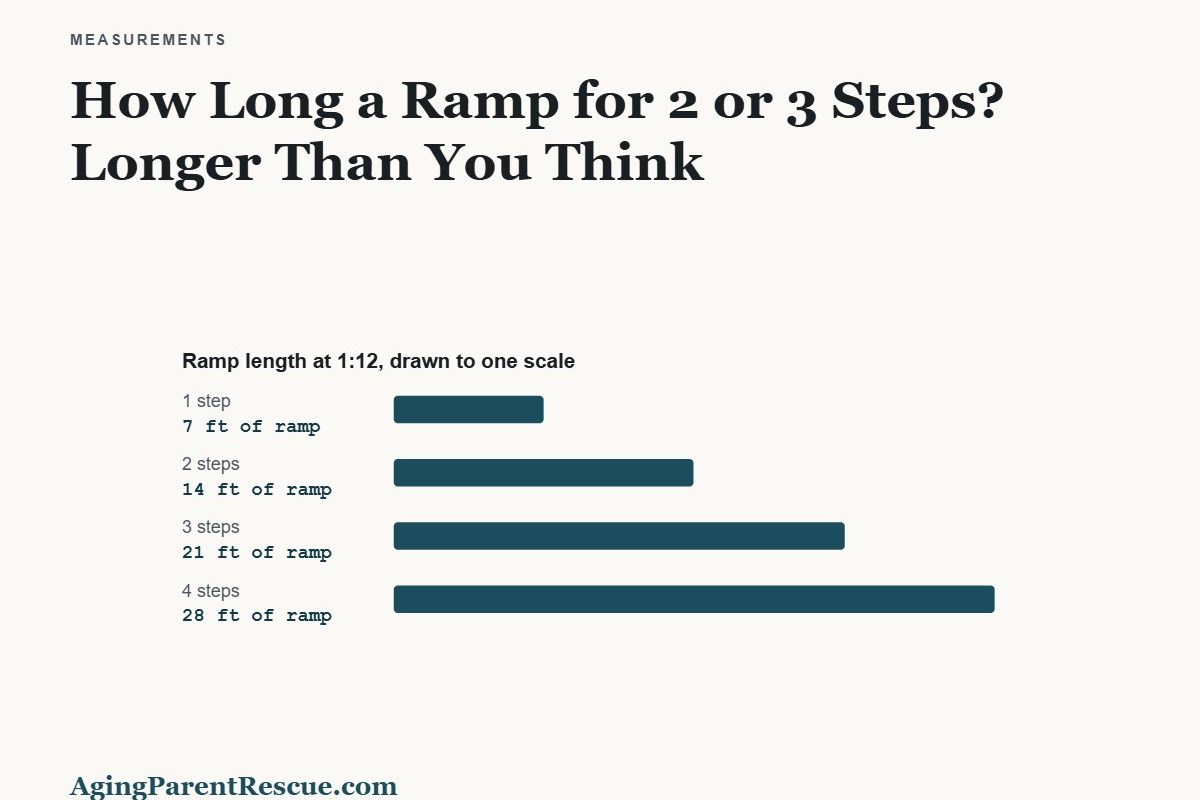
Every inch of height needs a foot of ramp. So two steps is roughly 14 feet of ramp and three steps is roughly 21 feet. Measure the total rise, not the number of steps.
1:12 is the maximum slope in ADA 405.2 for a ramp someone uses unassisted.
People ask this expecting an answer in the region of six or eight feet, because that is what a portable ramp looks like in a photograph. The real number for a normal set of front steps is closer to the length of a car and a half.
Do the arithmetic on rise, not on steps
Steps are not a standard size, so counting them is only a rough proxy. Measure the total rise: put a straight board from the top surface you are ramping to, out level over the ground, and measure straight down to the ground at the far end. That vertical distance is your rise.
Then multiply by 12. A rise of 14″ gives 168″, which is 14 feet. A rise of 21″ gives 21 feet. The number of feet of ramp happens to equal the number of inches of rise, which is a convenient accident of the 1:12 figure and the easiest way to remember it.
Measure from the finished ground, not the grass. If the ramp will land on a new concrete pad, measure to where the pad surface will be. And see what the slope figure means before you decide to deviate from it.
Why not just make it steeper
Because slope is not a comfort setting, it is the difference between a ramp someone can use and a ramp someone needs help on. Above 1:12 a person pushing their own chair loses the ability to stop and hold position halfway up, and going down, the chair wants to run away.
Steeper slopes exist for specific situations, and it is worth knowing what they are for. A helper pushing an occupied chair can manage something steeper for a short run. Steeper again is for loading an empty chair or a mobility scooter into a vehicle, with nobody sitting in it. Neither of those is a permanent entrance for someone who wants to leave the house on their own.
When 21 feet does not fit
It usually does not, and the answer is to stop thinking about a straight line.
Turn it. A switchback runs the ramp back on itself with a landing at the turn, so 21 feet of ramp fits in about 11 feet of yard. This is the standard solution and the reason most real ramps are L or U shaped.
Reduce the rise. If there is a lower point to land on — a side door with fewer steps, a garage floor, a patio one step down — ramping to that instead can halve the length. The best ramp is often not at the front door.
Raise the ground. Building up the landing area with fill or a raised pad cuts the rise directly. On sloping ground you can sometimes take several inches out of the problem before the ramp starts.
Change the machine. For a large rise, a vertical platform lift occupies a few square feet instead of thirty running feet. It costs considerably more and needs power and maintenance, but on a tight urban lot it may be the only thing that fits.
Runs cannot go on indefinitely. Above roughly 30″ of rise you need a level landing partway, and every turn needs a landing big enough to manoeuvre on. That is a structural and space requirement, not a nicety — a person who cannot rest partway up a long climb will not use the ramp. Ramps also need edge protection and a handrail on each side once they are more than a few inches off the ground.
Before you buy anything
Write down three numbers: total rise, the longest straight run the site allows, and the width available at the turn. Those three decide whether you are buying a modular ramp, building a wooden one, or looking at a lift. Ordering by step count alone is how people end up with a ramp that is too short and therefore too steep to use.