Hallway Width for a Wheelchair: 36 Inches to Pass, 60 to Turn
Aging Parent Rescue is a participant in the Amazon Services LLC Associates Program. We may earn a commission when you buy through links on our site, at no extra cost to you.
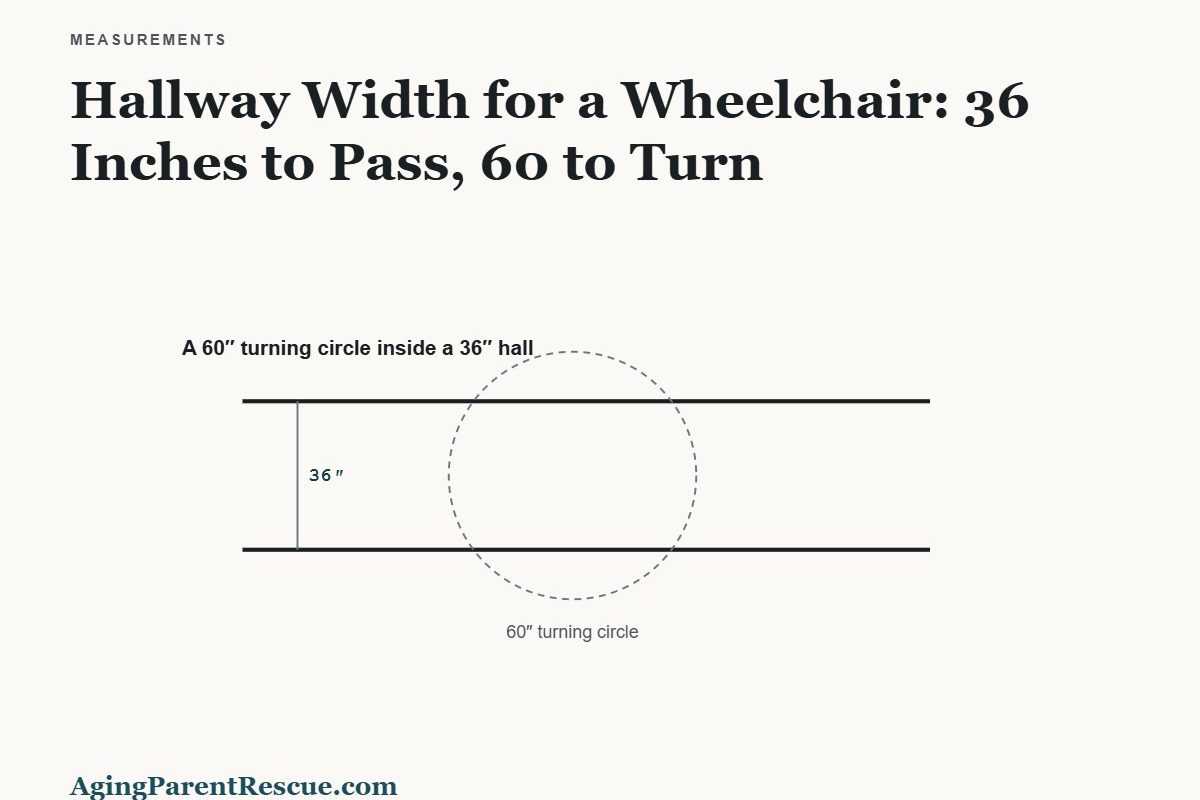
Clear width for travelling straight down a hall. It may pinch to 32″ for a short stretch, such as at a doorway. Turning around in place needs 60″.
Figures from ADA 403.5 and 304.3. Clear width means wall to wall with nothing in the way.
Hall width is the measurement people check last and should check first. A doorway that is too narrow is obvious the first time someone tries it. A hall that is too narrow fails in a subtler way: everything works until the chair has to change direction, and then nothing works.
36 inches gets you along, not around
At 36″ a standard chair travels comfortably in a straight line, with room to correct without scraping knuckles on the wall. That is genuinely all it buys you.
The rule allows a pinch to 32″ for a short length, up to about 24″ of travel. That exception exists for exactly one thing: passing through a doorway, where the frame narrows the opening for the thickness of the wall. It is not permission for a 32-inch corridor.
60 inches to turn or to pass
Two different needs land on the same number. Turning a chair through 180 degrees in place needs a clear circle of 60″. Two people passing each other, one of them in a chair, needs about the same.
Almost no house has a 60-inch hall, and the answer is not to widen it. You need somewhere that a turn can happen, not everywhere. A doorway opening off the hall, the space at the end, or a room off to the side all serve as the turning point, and a T-shaped junction works instead of a full circle: reverse into one arm of the T, then drive forward out of the other. That is how people actually turn in real houses.
What you must avoid is a long dead-end hall with no turning point at either end, because the only way out is reversing the whole length.
The doorway turn is the real problem
Going through a door straight on needs roughly the width of the chair. Turning ninety degrees out of a hall and into a door needs far more, because the chair has to swing while the front is already in the opening.
This is why a chair that measures 25″ can sail through a door off a wide landing and jam at the identical door at the end of a narrow hall. The chair did not change. The approach did.
You have three ways out, and widening the hall is the worst of them. Widen the door, which is a much smaller job and often solves it. Change the door to swing the other way or remove it, which recovers the depth its swing was eating. Or accept a narrower device indoors — a transport chair is often the practical answer for inside the house. Check the numbers against actual device widths and against the clear width of the doorway before deciding which.
Clear width means clear
Measure wall to wall at the narrowest point, then subtract everything that lives in the hall. A radiator, a shoe rack, a hall table, coats on hooks, a door that stands half open. All of it counts, and coats are the sneakiest because they compress and then spring back.
Measure at two heights as well: at floor level for skirting boards and at about elbow height, since hands and elbows stick out further than wheels. A hall that measures 36 inches at the floor and 33 at handle height is a 33-inch hall.
A narrow hall pushes wheels close to the walls, and a runner rug or a transition strip that would be harmless in the middle of a wide floor becomes a steering problem when there is no room to correct. If the hall is at the minimum, take the loose rug out rather than adding a non-slip pad to it. See the hallway checklist for the rest.