Portable Ramp Weight Capacity: Add Up the Chair, Not Just the Person
Aging Parent Rescue is a participant in the Amazon Services LLC Associates Program. We may earn a commission when you buy through links on our site, at no extra cost to you.
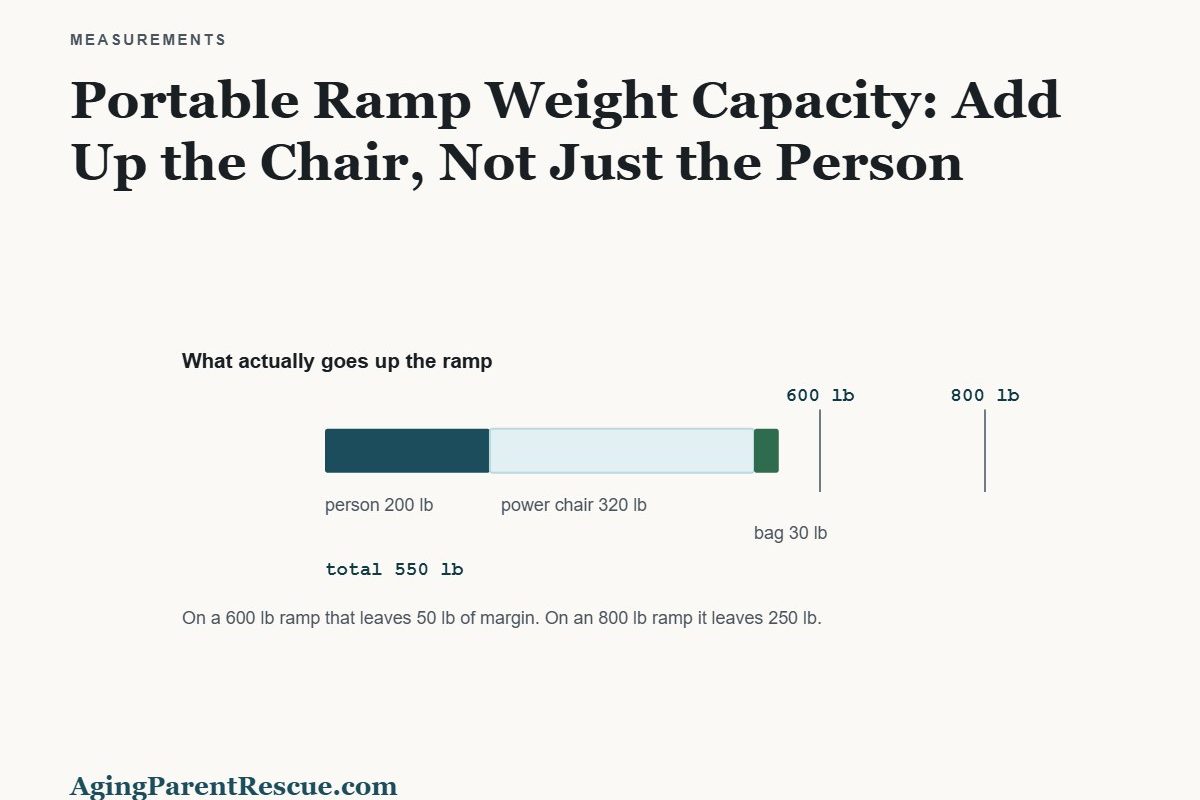
Typical rating range for portable and threshold ramps. The number you compare it against is person plus equipment plus anything carried, and the equipment is usually the bigger half.
Ratings vary by model and by length. The label on the ramp is the only figure that counts.
People check this number against their own body weight, decide 600 pounds is enormous, and stop thinking about it. Then they put a power chair on the ramp.
Do the sum in this order
Start with the equipment, because it is the part you will underestimate. A manual wheelchair is light, roughly 30–40 lb. A transport chair is lighter still. A power wheelchair is a different category entirely at 250–350 lb, most of it battery and motor. A mobility scooter lands somewhere in between.
Add the person. Add anything that travels with them: an oxygen cylinder, a bag hooked on the back, a tray, shopping. Then add a margin, because the rating is a limit and not a target.
If the total is within a hundred pounds of the rating, buy the next size up. Ramps do not fail gently and the cost difference between rating bands is small compared with everything else in this project.
Three things that quietly void the rating
Not supported at both ends. A rating assumes the ramp sits flat on the ground at the bottom and fully on the surface at the top. A ramp overhanging a step edge, or bridging a gap with air underneath the middle, is being loaded in a way nobody tested. This is the most common real-world failure and it usually looks fine.
Length. Many manufacturers publish a lower capacity for their longer ramps in the same range, because a longer span bends more under the same load. Check the rating for your length, not for the family of products.
A concentrated wheel load. Ratings are generally given for load spread across the ramp. A heavy power chair puts most of its weight through a small contact patch on two drive wheels. That is normal use and the ramps are designed for it, but it is another reason not to sit near the limit.
Width and surface matter as much as the number
A ramp rated for 800 pounds that is too narrow is still unusable. Measure the device before you buy: see how wide walkers, rollators and wheelchairs actually are, and allow room either side of that, not exactly that.
Surface is the other half. A ramp with a smooth painted finish becomes a slide when wet or icy, whatever it holds. Look for a grit or expanded-mesh surface, and check what the edges do — a raised lip stops a wheel wandering off the side, which a capacity figure says nothing about.
Portable ramps have no handrails, so they are appropriate for a very short rise where nobody needs something to hold. Once the rise is more than about 6″ a permanent ramp with handrails on both sides is the right answer, and the slope arithmetic starts to bite — see how long that has to be. Using a short portable ramp on a tall step to avoid building a real one produces a slope far too steep to control.
Checking one you already own
Find the label or the manual and write the rating on the ramp itself with a marker, because the sticker will come off and the number will be forgotten. Then look at the hinges and the surface. Portable ramps live outdoors, get dropped, and corrode at the folds. A ramp whose hinge has play in it is no longer carrying its rated load through the path it was designed to.