Ramp Handrail Height: 34 to 38 Inches, Both Sides
Aging Parent Rescue is a participant in the Amazon Services LLC Associates Program. We may earn a commission when you buy through links on our site, at no extra cost to you.
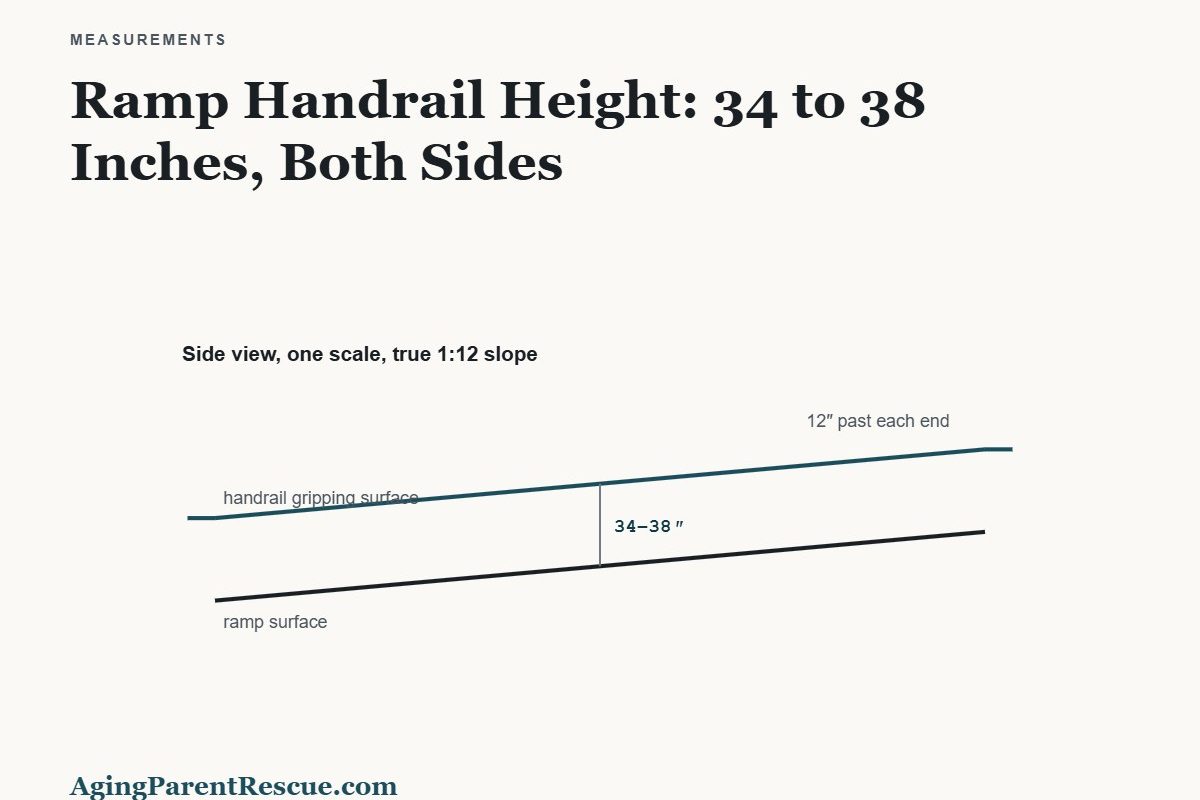
Measured from the ramp surface to the top of the gripping surface, straight up, at every point along the run. Both sides. Required once the ramp rises more than 6″.
Height from ADA 505.4, handrail trigger from 405.8, extensions from 505.10.1.
The height band is the same one used for stair handrails, and for the same reason: it is where a walking adult’s hand falls without reaching up or stooping. What changes on a ramp is that the rail has to stay a constant distance above a sloping surface, which is where installations go wrong.
Parallel to the ramp, not level to the ground
The commonest mistake is setting the posts to a level line, usually by eye or by matching an existing fence. The result is a rail that is the right height at one end, too low at the other, and outside the band for most of the run.
Set the height at the bottom of the run, set it again at the top, and string a line between. Every intermediate post is measured to that line, not to the ground. If the ramp has a landing partway, the rail stays at the same height above the landing surface too, so the rail changes angle where the ramp does.
Why 12 inches past each end matters
The extension is not decoration. At the top of a ramp, the person’s hand needs somewhere to hold while their chair or their feet are still on the slope and their body is transitioning to level ground. If the rail stops exactly where the slope stops, the hand comes off at the moment of the change.
At the bottom it does the same job in reverse, and it also gives someone approaching the ramp something to take hold of before they start climbing. The extension runs horizontally, parallel to the ground, not continuing the slope.
Both sides, and continuous
A ramp needs a handrail on each side. People are not symmetrical: a stroke, a weak shoulder or an arm carrying something all mean one particular side is the useful one, and which side that is changes depending on whether they are going up or coming down.
The gripping surface should also be continuous along the run. A rail broken by a post that interrupts the top surface forces the hand to let go and re-grip, and that happens at whatever point the builder chose rather than at a point the user chose. Posts should attach below the rail or to its outside face.
The rail itself
The same grip rules that apply to a grab bar apply here: circular section between 1¼″ and 2″, or a non-circular profile with a comparable perimeter and no sharp edges. Keep about 1½″ clear between the rail and any wall or post face, for the same reason as a grab bar’s wall gap: enough for a hand, not enough for a forearm.
A flat 2-by-4 laid on edge is the classic homemade rail and it fails the grip test in both dimensions. It is too wide to wrap a hand around and its corners dig in.
A handrail has to hold someone’s whole weight arriving suddenly and sideways. That means posts fixed into the ramp structure or into the ground, not screwed to decking boards, and it means checking them again after a winter. Ramps also need edge protection so a wheel cannot run off the side — a handrail alone does not stop a wheel, and the two are separate requirements. See also what the landings need.
The one exception worth knowing
A rise of 6 inches or less does not trigger the handrail requirement, which is why a single-step threshold ramp usually has none. That is a sensible cut-off for a very short ramp, but it is not permission to leave a rail off a long shallow one. A 20-foot ramp rising 6 inches is still 20 feet of surface someone can slide off sideways.